Country ETFs to Gain/Lose on Oil Price Rebound

Israel's Attack on Iran: Israel conducted a surprise "preemptive strike" against Iran, claiming it was necessary to counter Iran's nuclear weapons program, leading to explosions in Tehran and heightened tensions in the region.
Market Impact and ETF Insights: The attack caused a surge in crude oil prices by about 5%, affecting global commodity markets, with potential implications for various country-based exchange-traded funds (ETFs) related to oil production and economic dependency on oil imports.
Trade with 70% Backtested Accuracy
Analyst Views on TUR
About the author


Country ETFs to Gain/Lose on Oil Price Rebound


Israel's Attack on Iran: Israel conducted a surprise "preemptive strike" against Iran, claiming it was necessary to counter Iran's nuclear weapons program, leading to explosions in Tehran and heightened tensions in the region.
Market Impact and ETF Insights: The attack caused a surge in crude oil prices by about 5%, affecting global commodity markets, with potential implications for various country-based exchange-traded funds (ETFs) related to oil production and economic dependency on oil imports.

Turkey bans short selling as political turmoil fuels stock market rout


Market Response to Political Turmoil: Turkey has banned short selling in its stock market and eased share buyback rules following the arrest of opposition leader Ekrem Imamoglu, which led to a significant drop in the benchmark index and widespread protests.
Central Bank Actions: In response to market volatility and a record low for the Turkish lira, the Central Bank of the Republic of Türkiye raised interest rates unexpectedly and suspended one-week repo auctions, indicating a tightening of monetary policy if inflation worsens.
Turkey stock market down, lira falls to record low as Erdogan's rival, Istanbul mayor arrested
Turkish Lira and Market Reaction: The Turkish lira fell to a record low against the U.S. dollar, trading at 38.87, while Turkey's benchmark index dropped by 7% following the arrest of Istanbul Mayor Ekrem Imamoglu, a political rival of President Erdogan.
Political Implications of Arrest: Imamoglu's arrest is linked to corruption and terror probes, with warrants issued for 100 others; this event is seen as a "political coup" by CHP chairman Ozgur Ozel, occurring just before elections to select the opposition candidate for the 2028 presidential election.
Turkey cuts policy rate after indicators point to an increase in inflation
Turkey's Central Bank Rate Cut: The Central Bank of the Republic of Türkiye has reduced its policy rate by 250 basis points to 45%, citing a decrease in underlying inflation trends but anticipating an increase driven by service prices.
Monetary Policy Outlook: The central bank emphasizes maintaining a tight monetary stance to support disinflation, with future policy rates being adjusted based on realized and expected inflation trends.

Argentina and Turkey Defy Odds, Beat US Stock Market in 2024


U.S. Market Performance Compared to Others: While U.S. stocks, particularly the S&P 500, saw a 25% increase in 2024, Argentina's Merval index nearly tripled, and other emerging markets like Turkey, Hungary, and Taiwan also outperformed the U.S., highlighting that significant gains can be found outside of the U.S. market.
Economic Strategies and Outcomes: Countries like Argentina and Turkey implemented aggressive economic reforms to combat inflation and stabilize their economies, leading to substantial stock market gains despite ongoing challenges, while Mexico and Brazil struggled due to poor governance and economic policies.
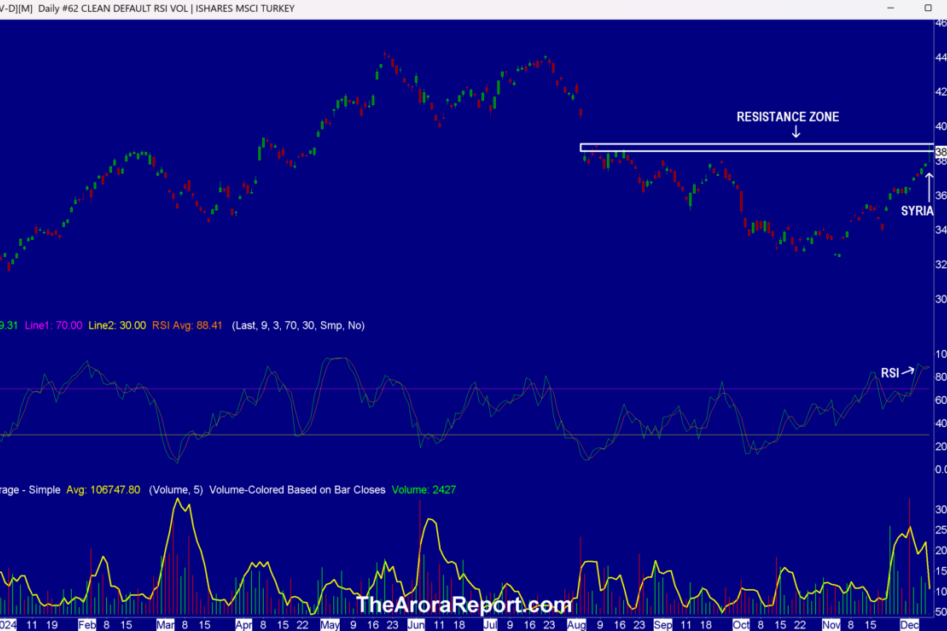
Power Vacuum In Syria Increases Geopolitical Instability, China Investigating Nvidia


Turkey's Position in the Syrian Conflict: The fall of Bashar al-Assad's regime in Syria has created a power vacuum, benefiting Turkey as foreign investments in Turkish stocks increase. Meanwhile, the U.S. continues airstrikes against ISIS, while Iran, Russia, and Hezbollah face losses.
Market Trends and Investment Strategies: Investors are shifting towards gold, silver, and oil due to instability, while cryptocurrencies like Bitcoin are declining. The Arora Report suggests maintaining long-term positions and using protection bands for risk management, especially in light of upcoming inflation data releases.
Country ETFs to Gain/Lose on Oil Price Rebound
Israel's Attack on Iran: Israel conducted a surprise "preemptive strike" against Iran, claiming it was necessary to counter Iran's nuclear weapons program, leading to explosions in Tehran and heightened tensions in the region.
Market Impact and ETF Insights: The attack caused a surge in crude oil prices by about 5%, affecting global commodity markets, with potential implications for various country-based exchange-traded funds (ETFs) related to oil production and economic dependency on oil imports.
Turkey bans short selling as political turmoil fuels stock market rout
Market Response to Political Turmoil: Turkey has banned short selling in its stock market and eased share buyback rules following the arrest of opposition leader Ekrem Imamoglu, which led to a significant drop in the benchmark index and widespread protests.
Central Bank Actions: In response to market volatility and a record low for the Turkish lira, the Central Bank of the Republic of Türkiye raised interest rates unexpectedly and suspended one-week repo auctions, indicating a tightening of monetary policy if inflation worsens.
Turkey stock market down, lira falls to record low as Erdogan's rival, Istanbul mayor arrested
Turkish Lira and Market Reaction: The Turkish lira fell to a record low against the U.S. dollar, trading at 38.87, while Turkey's benchmark index dropped by 7% following the arrest of Istanbul Mayor Ekrem Imamoglu, a political rival of President Erdogan.
Political Implications of Arrest: Imamoglu's arrest is linked to corruption and terror probes, with warrants issued for 100 others; this event is seen as a "political coup" by CHP chairman Ozgur Ozel, occurring just before elections to select the opposition candidate for the 2028 presidential election.
Turkey cuts policy rate after indicators point to an increase in inflation
Turkey's Central Bank Rate Cut: The Central Bank of the Republic of Türkiye has reduced its policy rate by 250 basis points to 45%, citing a decrease in underlying inflation trends but anticipating an increase driven by service prices.
Monetary Policy Outlook: The central bank emphasizes maintaining a tight monetary stance to support disinflation, with future policy rates being adjusted based on realized and expected inflation trends.
Argentina and Turkey Defy Odds, Beat US Stock Market in 2024
U.S. Market Performance Compared to Others: While U.S. stocks, particularly the S&P 500, saw a 25% increase in 2024, Argentina's Merval index nearly tripled, and other emerging markets like Turkey, Hungary, and Taiwan also outperformed the U.S., highlighting that significant gains can be found outside of the U.S. market.
Economic Strategies and Outcomes: Countries like Argentina and Turkey implemented aggressive economic reforms to combat inflation and stabilize their economies, leading to substantial stock market gains despite ongoing challenges, while Mexico and Brazil struggled due to poor governance and economic policies.
Power Vacuum In Syria Increases Geopolitical Instability, China Investigating Nvidia
Turkey's Position in the Syrian Conflict: The fall of Bashar al-Assad's regime in Syria has created a power vacuum, benefiting Turkey as foreign investments in Turkish stocks increase. Meanwhile, the U.S. continues airstrikes against ISIS, while Iran, Russia, and Hezbollah face losses.
Market Trends and Investment Strategies: Investors are shifting towards gold, silver, and oil due to instability, while cryptocurrencies like Bitcoin are declining. The Arora Report suggests maintaining long-term positions and using protection bands for risk management, especially in light of upcoming inflation data releases.