
Key Takeaway
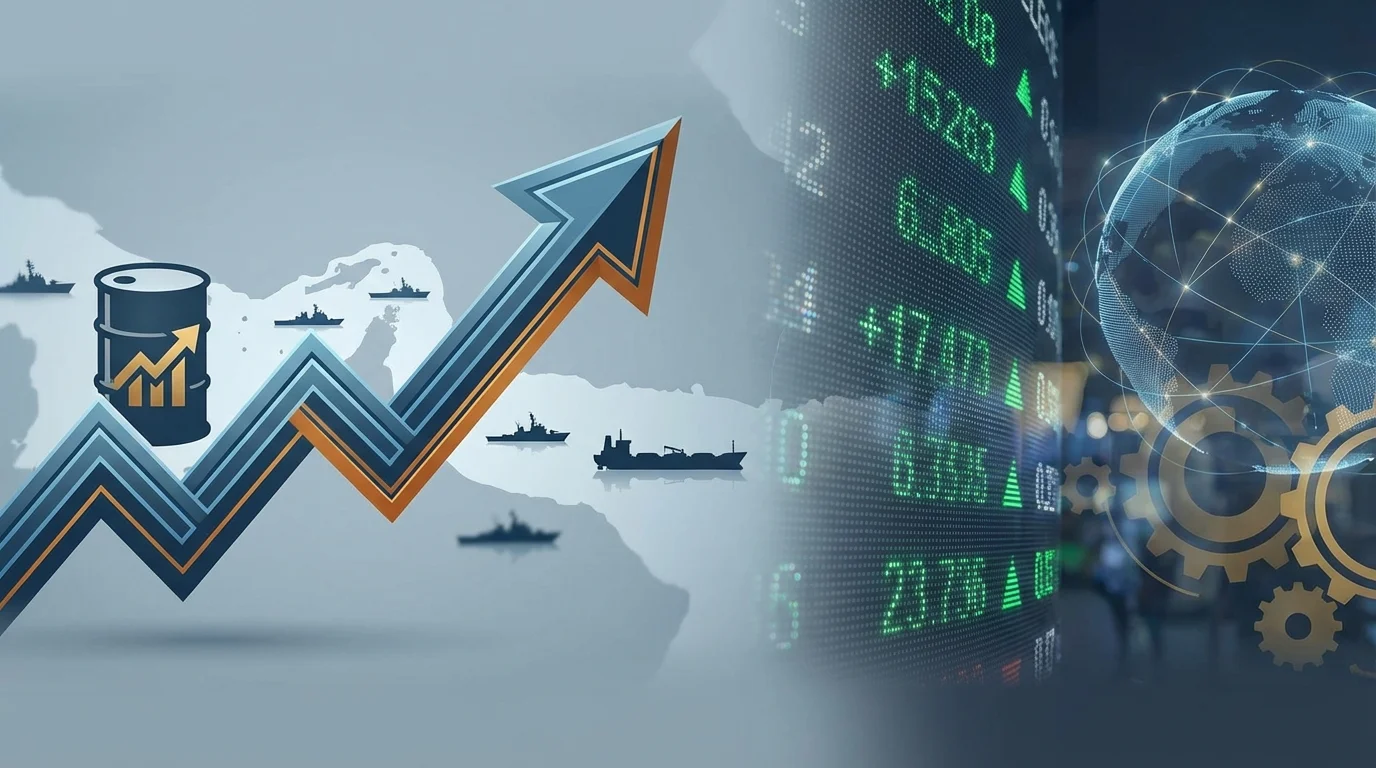
The US-Iran conflict has erupted into a full-blown oil crisis, with crude prices surging past $100 per barrel as the US Navy blockades Iranian ports through the strategically vital Strait of Hormuz. This crisis represents more than just a temporary spike in energy costs—it signals a fundamental shift in geopolitical risk premiums that could reshape global markets for months to come. West Texas Intermediate (WTI) crude climbed to $104 a barrel, marking a staggering 50% increase from pre-conflict levels, while investors scramble to reassess their exposure to energy-dependent sectors.
Goldman Sachs has emerged as an unlikely beneficiary of this chaos, posting its second-highest quarterly profit ever at $5.63 billion, driven by record trading revenues as market volatility creates opportunities for the banking giant. The juxtaposition of these two narratives—economic disruption and Wall Street profits—reveals the complex dynamics at play when geopolitical shocks ripple through interconnected global markets. For investors, the challenge lies in navigating extreme volatility while identifying which companies and sectors stand to gain or lose from prolonged energy market instability.
The immediate economic impact extends far beyond the energy sector. Rising oil prices threaten to reignite inflationary pressures that central banks have spent years trying to contain, potentially complicating monetary policy decisions at the Federal Reserve. With the 2026 economic recovery already fragile, the timing of this conflict couldn't be worse for policymakers seeking to engineer a soft landing. Every $10 increase in oil prices translates to approximately 0.3% of global GDP in economic drag, meaning the current spike could shave significant growth off already tepid forecasts.

Understanding the Strait of Hormuz Crisis
The Strait of Hormuz represents the most critical chokepoint in global energy markets, with roughly one-fifth of global petroleum liquids passing through this narrow waterway each day. When Iran signaled potential disruptions to the Strait following failed nuclear negotiations in Geneva, markets initially dismissed the rhetoric as typical geopolitical posturing. However, the situation escalated dramatically when the United States Central Command announced naval blockades of Iranian ports, effectively cutting off Tehran's primary revenue source.
Iran's oil exports, which had been tracking at approximately 1.7 million barrels per day, face an existential threat under the current blockade. This volume represents a significant portion of global supply, and its removal from markets has created immediate pressure on prices. The strategic calculus behind the US decision appears driven by multiple factors: pressuring Iran back to the negotiating table, protecting regional allies, and asserting control over a waterway vital to global commerce. Yet the economic consequences extend far beyond Iran's borders, affecting every oil-importing nation worldwide.
The conflict's roots trace back to a 12-day air conflict in 2025 that left tensions simmering between Iran, the United States, and Israel. Failed diplomatic efforts throughout early 2026, including conditional ceasefire deals that briefly opened the Strait only to see them collapse, have created a pattern of false hope followed by renewed escalation. This volatility has made it nearly impossible for energy traders and corporate planners to develop reliable forecasts, contributing to the risk premiums now embedded in oil prices.
Market observers note that the volume of ships passing through the Strait needs to surge substantially within the next two weeks for confidence to return. Until then, energy markets will remain on edge, with every diplomatic statement or military action capable of moving prices by several percentage points in minutes. This environment rewards sophisticated trading operations while punishing long-term investors seeking stability.
The Oil Market's Wild Ride: From $92 to $104 and Back
Oil markets have experienced extraordinary volatility over the past week, with prices swinging more than 12% in either direction based on the latest headlines from diplomatic channels. WTI crude's journey from below $92 to $104 and back again illustrates just how sensitive energy markets have become to geopolitical developments. For context, oil had briefly plunged below $100 last Wednesday when the US and Iran struck a conditional two-week ceasefire deal, only to spike again when talks broke down.
This volatility creates winners and losers across the economy. Exploration and production companies with existing operations see their margins expand dramatically with each price increase, while integrated oil majors benefit from upstream gains even as refining margins come under pressure. Conversely, airlines, shipping companies, and any business with significant transportation costs face margin compression that could take quarters to pass through to customers via price increases.
The futures curve tells an equally interesting story. Backwardation—where near-term contracts trade at premiums to longer-dated ones—has steepened significantly, indicating markets expect the supply disruption to be temporary but intense. This structure actually encourages inventory drawdowns rather than builds, as holders of physical oil can sell at spot premiums while delaying purchases. The result is a tight physical market that could see prices spike even higher if any additional supply disruptions occur.
For commodity investors, the current environment demands sophisticated risk management. Traditional buy-and-hold strategies in energy ETFs or oil futures have proven treacherous, with leveraged products experiencing dramatic volatility that can wipe out positions in hours. Instead, many professional traders are employing options strategies that profit from continued volatility while limiting downside exposure. The intellectia.ai screener can help identify energy companies best positioned to benefit from current price dynamics while maintaining strong balance sheets to weather potential reversals.
Goldman Sachs: Profiting From Market Chaos
While the oil crisis creates uncertainty for most businesses, Goldman Sachs has transformed market volatility into record-breaking profits. The banking giant reported first-quarter 2026 earnings that exceeded even optimistic analyst projections, with net revenues reaching $17.23 billion and net earnings hitting $5.63 billion. This represents a 19% year-over-year increase in profit, driven primarily by the firm's trading operations which thrive when markets move dramatically.
The numbers tell a remarkable story: earnings per share of $17.55 crushed the $16.49 consensus estimate, while the firm's return on common equity reached an impressive 19.8%. Assets under supervision hit a record $3.65 trillion, demonstrating that even as markets churn, institutional clients continue entrusting Goldman with their capital. The bank's equities desk, in particular, delivered a record quarter as heightened volatility generated trading opportunities across global markets.
This performance highlights a fundamental truth about financial markets—while volatility creates anxiety for most investors, it generates profits for sophisticated trading operations. Goldman's risk management systems, global footprint, and deep client relationships position it to capture spreads and execute strategies that smaller firms simply cannot access. When oil prices swing 10% in a single session based on diplomatic tweets, there are profits to be made by those with the technology and expertise to trade around the noise.
However, Goldman's stock has experienced its own volatility despite stellar earnings. Shares erased more than 3% gains for 2026 following the earnings release, suggesting investors worry that current trading profits may not be sustainable once geopolitical tensions ease. The bank's management has emphasized diversified revenue streams and long-term growth initiatives, but markets clearly view the current quarter as potentially peak earnings rather than a new baseline.
For investors considering financial sector exposure, Goldman's results demonstrate the value of owning quality franchises during uncertain times. While regional banks face deposit flight and credit concerns, global investment banks with trading operations can offset weakness in traditional lending with market-making profits. The intellectia.ai stock picker provides analysis of which financial institutions are best positioned to navigate the current environment while maintaining attractive valuations.
Economic Implications: Inflation, Growth, and Fed Policy
The surge in oil prices carries profound implications for the broader economy, threatening to derail the fragile recovery that had been taking shape in early 2026. Every sustained $10 increase in crude prices translates to higher costs across the entire supply chain, from transportation and manufacturing to agriculture and consumer goods. These input cost pressures arrive at a particularly sensitive moment, with inflation having only recently shown signs of moderating toward central bank targets.
The Federal Reserve now faces an unenviable dilemma. Elevated oil prices threaten to reignite inflationary pressures just as policymakers were contemplating rate cuts to support slowing growth. If the Fed responds to inflation by maintaining higher rates for longer, they risk exacerbating the economic drag from expensive energy. Conversely, cutting rates to support growth while oil prices surge could allow inflation expectations to become unanchored, potentially triggering a wage-price spiral.
Historical precedents offer little comfort. The 1970s oil shocks demonstrated how supply-driven energy inflation can persist even during economic weakness, creating the dreaded stagflation scenario where growth stalls while prices rise. While the US economy is less energy-intensive today than in that era, the structural dependence on oil for transportation and petrochemicals means sustained high prices will inevitably flow through to consumer prices.
The political dimension adds another layer of complexity. The conflict is reportedly unpopular domestically, with rising energy prices causing political blowback for the administration. This pressure could accelerate diplomatic efforts to reach a resolution, but could also lead to policy mistakes if political expediency overrides strategic considerations. Investors must monitor not just market fundamentals but the shifting political calculus that could suddenly alter the trajectory of the crisis.
For consumers, the immediate impact is visible at the gas pump, where prices have already risen sharply and could climb higher if the conflict persists. This inflation in essentials reduces discretionary spending power, potentially dragging on retail sales and service sector activity just as those areas were showing resilience. The combination of high inflation and slowing growth represents the worst-case scenario for household finances and corporate earnings alike.
Investment Strategies for Volatile Energy Markets
Navigating the current environment requires a differentiated approach that recognizes both the risks and opportunities created by oil market volatility. Passive index investing, which has served investors well during the decade-long bull market, may prove inadequate when sector dispersion is extreme and correlations break down. Instead, active strategies that can rotate between beneficiaries and victims of high energy prices may outperform.
On the long side, exploration and production companies with low production costs and strong balance sheets stand to benefit from sustained higher prices. Companies that hedged production at lower levels may underperform as they miss out on upside, while those with unhedged exposure capture the full benefit of spot prices. Integrated oil majors offer a more defensive play, with downstream operations providing a partial hedge against upstream volatility while dividend yields provide income during uncertain times.
Conversely, sectors vulnerable to energy costs deserve scrutiny. Airlines face immediate margin pressure as jet fuel represents a significant portion of operating costs, and their ability to pass increases to customers through fuel surcharges is limited by competitive dynamics. Shipping companies, trucking firms, and any business with significant logistics exposure face similar challenges. Consumer discretionary stocks may suffer as households divert spending from non-essentials to cover higher transportation and heating costs.
Alternative energy stocks present an interesting contrarian opportunity. While higher oil prices theoretically improve the competitive position of renewables, these stocks have often traded inversely with oil during risk-off periods as investors sell anything speculative. However, for investors with longer time horizons, the current crisis underscores the strategic vulnerability of fossil fuel dependence and could accelerate the transition to cleaner energy sources.
Defensive positioning also merits consideration. Utilities with regulated rate bases can pass through fuel costs to customers, while consumer staples companies with pricing power can maintain margins despite input inflation. Gold and precious metals may benefit if the crisis triggers broader risk aversion or raises questions about the dollar's stability. The key is building portfolios that can weather multiple scenarios rather than betting on a single outcome.
Global Market Response and International Diversification
The crisis has highlighted the value of international diversification, with non-US markets responding differently to the conflict depending on their energy import exposure and geographic positioning. European markets, heavily dependent on imported energy, have shown more volatility than their American counterparts, while energy-exporting nations in the Middle East and parts of Asia have actually benefited from higher prices. This dispersion creates opportunities for globally diversified portfolios to outperform concentrated domestic exposures.
The MSCI ACWI advanced 4.14% during the most recent week, with the MSCI World gaining 3.70%, demonstrating that despite the headline risks, global equity markets have remained resilient. International diversification has been one of the most rewarding portfolio decisions of 2026, as geographic rotation allows investors to capture exposure to regions less affected by specific geopolitical shocks. When US-Iran tensions spike, having exposure to Latin American, Asian, or African markets provides valuable ballast.
Currency markets have also reacted, with the dollar's safe-haven appeal initially strengthening before waning as hopes for diplomatic resolution emerged. Oil-importing currencies like the Japanese yen and Indian rupee have come under pressure as their trade deficits widen with expensive energy imports. Conversely, currencies of commodity-exporting nations such as the Canadian dollar and Australian dollar have found support from improved terms of trade.
Emerging markets present a particularly complex picture. Oil-importing emerging economies face the double whammy of expensive energy and potential capital flight if investors seek safety in developed market assets. However, select emerging markets with strong domestic demand and limited external vulnerabilities may offer compelling valuations after any risk-off selling. The key is distinguishing between fundamentally sound economies experiencing temporary stress and those facing structural challenges exacerbated by the crisis.
For investors considering international exposure, the current environment favors quality over speculative growth. Companies with strong balance sheets, dominant market positions, and pricing power are better positioned to navigate currency volatility and input cost pressures than leveraged growth stories dependent on cheap financing. Dividend-paying stocks in stable jurisdictions offer both income and the potential for currency appreciation if the dollar weakens in response to prolonged conflict.
Diplomatic Outlook: Paths to Resolution or Escalation
Despite the military posturing and naval blockades, diplomatic channels remain open, with reports suggesting the US and Iran may resume talks this week. The conditional ceasefire that briefly opened the Strait demonstrated that both sides recognize the economic costs of prolonged conflict, even if political constraints make compromise difficult. The key question for markets is whether any diplomatic resolution can be durable or if we face a cycle of temporary truces followed by renewed escalation.
The US administration faces conflicting pressures. On one hand, the domestic political cost of high energy prices creates incentives to reach a deal quickly. On the other hand, appearing weak on Iran carries its own political risks, and allies in the region expect decisive action against what they view as Iranian aggression. This balancing act means any resolution will likely be messy and partial rather than a clean breakthrough.
Iran's calculus is equally complex. The blockade threatens the regime's primary revenue source, creating economic pressure that could fuel domestic unrest. Yet backing down in the face of American threats risks appearing weak both domestically and regionally, potentially inviting further pressure on other fronts. The regime may prefer a prolonged standoff that gradually erodes sanctions enforcement while avoiding full-scale military confrontation.
For investors, the diplomatic uncertainty creates a challenging forecasting environment. Scenario planning should consider multiple outcomes: a quick resolution that sends oil prices back toward $70, a prolonged standoff that keeps prices elevated for months, or worst-case military escalation that could drive prices above $150. Position sizing and risk management become critical when potential outcomes span such a wide range.
The role of other global powers adds another variable. China and India, major importers of Iranian oil, have incentives to see the crisis resolved but also benefit from discounted Iranian crude that evades sanctions. Russia's position is ambiguous—higher oil prices benefit its energy exports, but the precedent of US military action against oil exporters may concern Moscow. These competing interests mean any resolution will require complex multilateral coordination rather than bilateral US-Iran negotiations.
Conclusion: Navigating Uncertainty with Data-Driven Insights
The US-Iran conflict and resulting oil market volatility represent exactly the type of complex, fast-moving situation where emotional decision-making leads to costly mistakes. Investors tempted to panic-sell energy-sensitive holdings at depressed prices or chase momentum in oil stocks at elevated levels should pause and consider the range of potential outcomes. History shows that geopolitical crises, however frightening in the moment, eventually resolve—and those who maintained disciplined, diversified approaches are rewarded.
That said, doing nothing is not a strategy either. The current environment demands active portfolio management to ensure exposures align with your risk tolerance and investment horizon. This means stress-testing portfolios against sustained high oil prices, evaluating whether current holdings can weather the economic scenarios that could unfold, and identifying opportunities created by market dislocations.
Sophisticated investors are using this period to upgrade portfolio quality, rotating from vulnerable companies toward those with pricing power, strong balance sheets, and durable competitive advantages. They're also employing tools like the intellectia.ai stock picker to identify opportunities in the chaos, using AI-powered analysis to process vast amounts of market data and uncover insights that human analysts might miss.
The Goldman Sachs earnings demonstrate that even in crisis, there are profits to be made by those with the right tools and temperament. While retail investors panic, professionals systematically identify dislocations and position for eventual normalization. The key difference is access to information and analysis capabilities that cut through noise to identify signal.
For those looking to navigate these markets with confidence, consider exploring the intellectia.ai platform. Our AI-powered screening tools, real-time analytics, and institutional-grade data can help you separate genuine opportunities from value traps during volatile periods. Whether you're looking to hedge existing exposure, identify energy sector winners, or simply understand how the crisis affects your portfolio, having the right analytical tools makes all the difference.
Markets have weathered countless geopolitical storms throughout history, and this crisis will eventually pass as well. The question is whether you'll emerge from it with your portfolio intact and positioned for the recovery, or whether emotional reactions will lock in losses that take years to recover. In times like these, data-driven decision-making isn't just an advantage—it's essential.
Ready to take control of your investment strategy during these uncertain times? Sign up for intellectia.ai today and get access to the same caliber of analytical tools that institutions use to navigate market volatility. Your financial future deserves nothing less than the best intelligence available.