
Key Takeaway
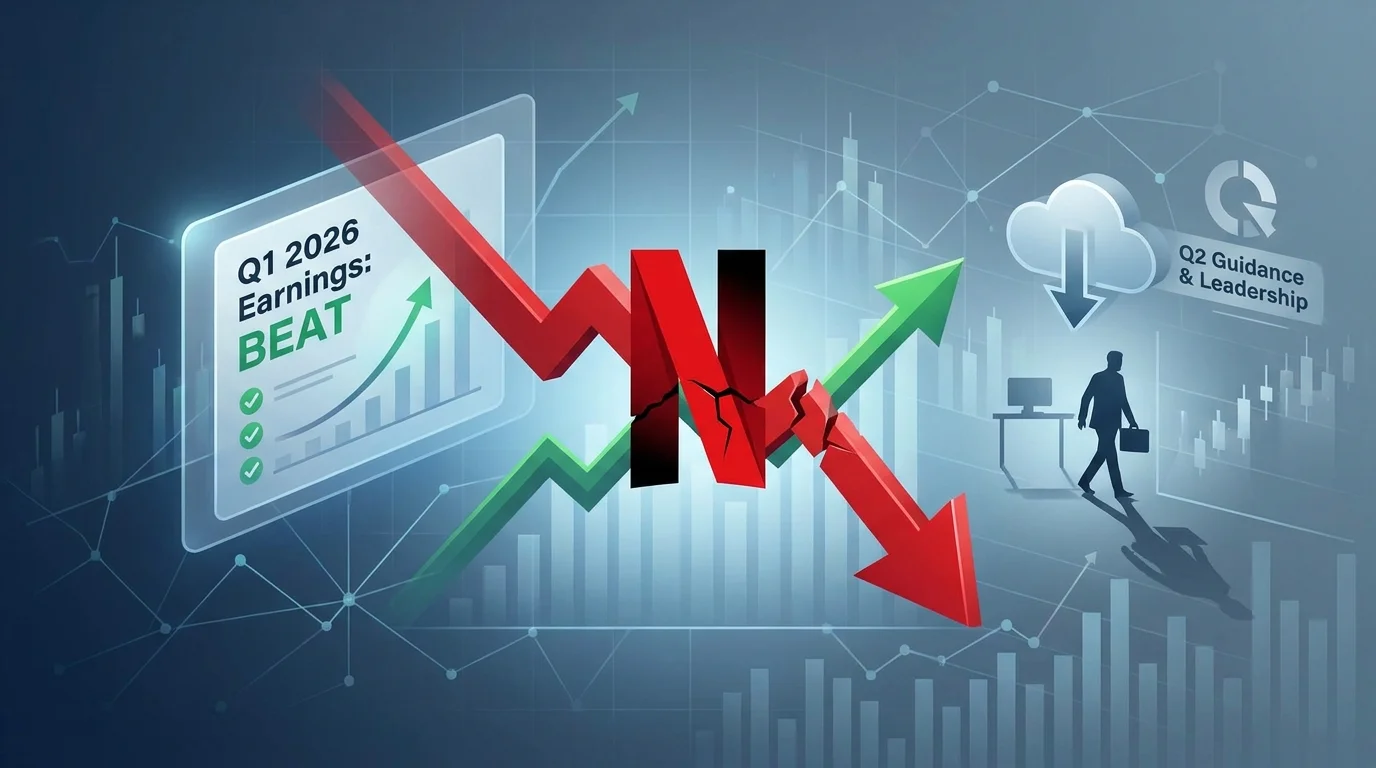
Netflix delivered a classic earnings paradox in April 2026 that left investors scratching their heads. The streaming giant beat Wall Street expectations on both revenue and profit metrics for the first quarter, yet its stock price plummeted nearly 10% in after-hours trading and continued sliding into the following session. The disconnect between strong historical performance and disappointing forward guidance created a perfect storm of negative sentiment, compounded by the surprise announcement that co-founder and Chairman Reed Hastings would be stepping down from the board. This sell-off reflects broader concerns about Netflix's growth trajectory as it matures in saturated markets and faces intensifying competition from both traditional media and tech giants entering the streaming wars.
For investors considering whether this dip represents a buying opportunity or the start of a more significant correction, understanding the nuances of Netflix's guidance miss, its strategic positioning, and the implications of its leadership transition becomes essential. The company's fundamentals remain robust with operating income jumping 18% to $4.08 billion and free cash flow skyrocketing to $5.1 billion from $2.7 billion year-over-year. However, the market's reaction signals that investors were pricing in much more aggressive growth expectations following recent price increases and the company's aggressive push into advertising and gaming initiatives.
Are you looking for AI-powered stock analysis to navigate earnings surprises like Netflix's? Discover how Intellectia.AI's stock analysis tools can help you identify buying opportunities during market volatility.

Netflix Q1 2026 Earnings: The Numbers Behind the Miss
Netflix's first-quarter 2026 results on paper appeared to be a resounding success. The company reported earnings that exceeded Wall Street consensus expectations of 76 cents per share, while total revenue of approximately $12.18 billion also beat analyst forecasts. Operating income surged to $4.08 billion, significantly above the estimated $3.94 billion, demonstrating the company's ability to expand profitability even as it invests heavily in content production and technology infrastructure. Free cash flow generation was particularly impressive, more than doubling from $2.7 billion in the prior year period to $5.1 billion, crushing expectations of $2.87 billion.
Despite these headline beats, the market focused intensely on two concerning data points that emerged during the earnings call. First, the company's operating margin of 31.7% fell short of the 32.5% forecast, raising questions about whether Netflix can maintain its historical margin expansion trajectory as content costs escalate and competition forces increased marketing spend. Second, and more significantly, Netflix maintained its full-year 2026 revenue outlook between $50.7 billion and $51.7 billion, a range that falls slightly below analyst expectations of $51.38 billion. For a stock trading at premium valuation multiples, any hint of slowing growth momentum can trigger severe multiple compression.
The second-quarter revenue guidance projecting 13% year-over-year growth also underwhelmed investors who had hoped the company's recent price increases across multiple tiers would translate into more aggressive top-line acceleration. Management reiterated their earlier warning that content spending would be weighted toward the first half of 2026 due to the timing of major title launches, which creates a natural headwind for subscriber growth in subsequent quarters. This seasonality explanation failed to satisfy a market accustomed to Netflix consistently raising guidance throughout earnings seasons.
Why the Market Punished Netflix Despite Strong Results
The disconnect between Netflix's solid quarterly performance and its stock price collapse reveals important insights about how institutional investors evaluate growth companies at different stages of their lifecycle. Netflix has transitioned from a high-growth disruptor to a mature cash-generating giant, fundamentally changing how the market prices its equity. When a company consistently beats expectations quarter after quarter, investors begin baking aggressive future growth into current valuations, creating an environment where merely meeting expectations becomes viewed as disappointment.
The guidance miss carried particular weight because it suggested that Netflix's recent price increases across its subscription tiers weren't translating into the revenue acceleration investors had anticipated. After successfully implementing ad-supported tiers and cracking down on password sharing in previous years, Netflix appeared to be running out of obvious levers for rapid subscriber growth in its most mature markets. The company's aggressive international expansion has driven impressive user numbers, but average revenue per user remains significantly lower in emerging markets compared to North America and Western Europe.
Institutional investors have also become increasingly concerned about the sustainability of Netflix's content cost inflation. The company's spending on original programming has ballooned into the tens of billions annually as it competes with deep-pocketed rivals like Disney, Amazon, and Apple for top-tier talent and intellectual property. While Netflix has demonstrated impressive operating leverage historically, the market is questioning whether content cost growth will begin outpacing revenue growth, compressing the margins that have made the company so attractive to investors.
The competitive landscape has evolved dramatically since Netflix dominated the streaming conversation five years ago. Disney+ has emerged as a formidable competitor with its unmatched content library, while Amazon leverages its Prime ecosystem to offer video streaming as a loss leader. Tech giants like Apple and Google continue investing billions in original content, fragmenting viewer attention and driving up talent costs across the industry. Netflix's first-mover advantage has eroded, forcing the company to fight harder for every subscriber acquisition.
Reed Hastings Departure: Leadership Transition Adds Uncertainty
Perhaps the most surprising element of Netflix's earnings announcement was the revelation that co-founder and Chairman Reed Hastings would be stepping down from the board, effective immediately. Hastings has been the visionary architect behind Netflix's transformation from a DVD-by-mail service to the world's dominant streaming platform, making his departure a significant symbolic moment for the company and its investors. While Netflix has operated under co-CEO structure for several years with Ted Sarandos and Greg Peters sharing operational responsibilities, Hastings maintained strategic oversight that provided continuity through various market cycles.
The timing of Hastings' exit intensified investor anxiety because it coincided with what the market perceived as disappointing guidance. Questions immediately arose about whether Hastings' departure reflected confidence in the current leadership team's ability to navigate the next phase of growth, or alternatively, whether he saw strategic challenges on the horizon that influenced his decision to step away. Netflix's communications emphasized a planned transition and Hastings' desire to focus on philanthropy, but markets often interpret founder departures during periods of volatility as concerning signals.
Investors will be closely watching how Sarandos and Peters navigate the company through its next growth phase without Hastings' strategic oversight. The co-CEO structure has generally functioned effectively, but major strategic decisions—such as the company's controversial pivot toward gaming and its aggressive push into live events including sports—will now test the leadership team's unified vision. Netflix's ability to maintain its innovative culture and strategic agility without its founder's guiding presence represents an unquantifiable risk factor that the market is now pricing into shares.
The leadership transition also raises questions about Netflix's long-term strategic priorities. Under Hastings, the company maintained a singular focus on subscriber growth and engagement metrics above short-term profitability, a philosophy that enabled Netflix to outspend competitors and build an insurmountable content library. As the company matures and faces pressure from activist investors and valuation-conscious shareholders, the new leadership team may face difficult decisions about balancing growth investments against shareholder returns through buybacks and dividends.
Netflix Valuation: Is the Stock Undervalued After the Drop?
Netflix's 10% correction following earnings has brought its valuation down to levels that some analysts argue represent a compelling buying opportunity. Before the earnings miss, NFLX shares had appreciated approximately 15% year-to-date, significantly outperforming broader market indices. The post-earnings decline brings the stock closer to historical valuation multiples that had become stretched amid the broader tech rally. Several major Wall Street firms, including Morgan Stanley, issued buy recommendations following the dip, arguing that the market overreacted to guidance that remains consistent with long-term growth targets.
From a fundamental perspective, Netflix continues demonstrating impressive cash generation capabilities that support its equity value. The company's $5.1 billion in free cash flow during Q1 2026 represents a dramatic improvement from its historical cash burn during the peak content investment years. This cash flow generation provides Netflix with significant strategic optionality, allowing the company to return capital to shareholders through buybacks, pursue strategic acquisitions, or accelerate debt repayment to strengthen its balance sheet. The transformation from a cash-consuming growth story to a cash-generating compounder represents a significant evolution in the investment thesis.
However, valuation analysis must also account for the competitive and regulatory headwinds that could constrain future growth. Netflix faces increasing regulatory scrutiny in international markets, with various governments proposing local content quotas and restrictions on foreign streaming services. The company's gaming and advertising initiatives, while promising, remain nascent businesses that may require years of investment before generating meaningful revenue contributions. Investors must weigh these growth optionality factors against the core streaming business's maturation in developed markets.
The analyst community remains divided on Netflix's near-term trajectory, with price targets ranging from bearish calls below current levels to bullish projections suggesting 30% upside from post-earnings prices. Bulls argue that Netflix's content moat, international expansion runway, and pricing power create a durable competitive advantage that the market is undervaluing. Bears counter that competitive intensity, content cost inflation, and subscriber saturation in core markets justify a lower multiple than Netflix has historically commanded. The truth likely lies somewhere between these extremes, with the stock requiring patience from investors willing to look through near-term volatility.
Streaming Industry Outlook: Netflix's Position in a Crowded Market
The broader streaming industry faces a pivotal inflection point as the gold rush mentality of the past decade gives way to a focus on sustainable profitability and subscriber retention. Netflix remains the largest pure-play streaming service by a significant margin, with over 260 million global subscribers compared to Disney+'s approximately 150 million. However, the gap has narrowed as competitors have ramped up content spending and improved their technology platforms to match Netflix's user experience. The industry is transitioning from a land grab phase to a retention and monetization phase, favoring companies with the strongest content libraries and most sophisticated recommendation algorithms.
Netflix's competitive moat extends beyond subscriber numbers to include its proprietary technology infrastructure, global content distribution capabilities, and unmatched data on viewer preferences. The company's recommendation engine, powered by sophisticated machine learning algorithms, drives higher engagement and lower churn than competitors can achieve. Netflix's willingness to invest in local language content across dozens of markets creates programming that resonates deeply with international audiences, a strategy that American-centric competitors have struggled to replicate effectively. These advantages don't disappear overnight, even as competition intensifies.
The industry's evolution toward advertising-supported tiers presents both opportunities and challenges for Netflix. The company's ad-supported tier, launched relatively recently compared to competitors, has gained traction but faces execution challenges around ad targeting and measurement that tech giants like Google and Meta have mastered over decades. Netflix's decision to invest in building its own ad technology platform rather than outsourcing to established players reflects confidence in its long-term ambitions but also creates near-term friction as the company scales this business. Success in advertising could significantly expand Netflix's total addressable market and improve unit economics, but failure would represent a costly strategic misstep.
Live events and sports represent another frontier where Netflix is testing its ability to expand beyond traditional scripted and unscripted content. The company's foray into live programming, including comedy specials and wrestling events, signals ambitions to capture viewing occasions that have historically belonged to broadcast and cable television. Sports rights remain the holy grail of streaming, with Netflix reportedly exploring opportunities to acquire major league broadcasting rights. While sports content commands premium pricing, the live viewing experience drives subscriber acquisition and creates appointment viewing that reduces churn. Netflix's ultimate success in live content will significantly influence its long-term competitive positioning.
Analyst Recommendations: Should You Buy the Dip?
Wall Street's reaction to Netflix's earnings miss has been remarkably consistent, with the majority of analysts maintaining buy ratings and viewing the selloff as an overreaction to temporary headwinds. Morgan Stanley issued a particularly bullish note, arguing that Netflix's core business fundamentals remain intact and that the guidance miss reflects conservative management rather than deteriorating demand. The firm emphasized that Netflix's free cash flow generation and pricing power create downside protection that justifies a premium valuation relative to media peers. Other major firms including Goldman Sachs and JPMorgan echoed these sentiments, with most maintaining price targets well above current trading levels.
The buy-the-dip narrative rests on several key assumptions that investors should evaluate carefully. First, analysts assume that Netflix's content spending will eventually moderate while revenue continues growing, creating significant margin expansion. Second, they believe international markets offer sufficient growth runway to offset saturation in North America. Third, they assume Netflix's gaming, advertising, and live events initiatives will eventually contribute meaningfully to revenue without cannibalizing the core streaming business. If these assumptions prove correct, current prices could represent an attractive entry point.
However, contrarian investors raise valid concerns about the streaming industry's structural economics. The proliferation of competing services has created a fragmented viewing landscape where consumers rotate subscriptions based on content release schedules, potentially increasing churn rates industry-wide. Content costs continue escalating as talent and sports rights become more expensive, potentially compressing margins across the sector. Regulatory scrutiny of large tech and media platforms could also impose additional compliance costs or restrict Netflix's ability to operate in certain markets.
Individual investors considering Netflix should assess their risk tolerance and investment time horizon. The stock has historically been volatile, with significant drawdowns occurring during periods of growth concern or competitive threat perception. Long-term investors who believe in Netflix's content creation capabilities, technology advantages, and international expansion potential may find current prices attractive for building positions. More risk-averse investors might prefer waiting for greater clarity on second-quarter results and management's updated guidance before committing capital.
Conclusion
Netflix's 10% post-earnings decline represents a classic case of expectations getting ahead of reality in growth investing. The company delivered solid quarterly results that demonstrated continued profitability expansion and impressive cash generation, yet the stock sold off because forward guidance failed to meet the aggressive expectations baked into its premium valuation. This dynamic illustrates the challenge facing mature growth companies: maintaining the growth rates that justify high multiples becomes increasingly difficult as the business scales.
For investors evaluating Netflix at current levels, the key question is whether the company's competitive advantages—its global content library, technology infrastructure, and brand recognition—remain durable enough to support continued growth despite intensifying competition. The answer likely depends on execution in newer initiatives like advertising, gaming, and live events, as well as the company's ability to maintain pricing power in core markets while expanding internationally. Reed Hastings' departure adds leadership risk to the equation, though the co-CEO structure has been in place long enough to provide continuity.
The analyst community's consensus buy recommendation reflects confidence that Netflix's recent selloff represents a temporary dislocation rather than a fundamental deterioration in the investment thesis. The company's transformation from a cash-burning growth story to a free-cash-flow-generating machine provides financial flexibility that many competitors lack. However, investors should remain realistic about the streaming industry's maturation and the increasing difficulty of finding new growth levers at Netflix's current scale.
Whether Netflix stock represents a compelling buying opportunity ultimately depends on individual investor conviction about the company's ability to navigate its next growth phase. The 10% discount from recent highs provides a better entry point than has been available for most of 2026, but the stock is unlikely to revisit its previous valuation multiples without evidence that growth is reaccelerating. Patient investors with long time horizons may find current prices attractive, while those seeking immediate returns might face continued volatility as the market digests Netflix's evolving story.
Ready to identify the next big stock opportunity before the market catches on? Sign up for Intellectia.AI and access AI-powered stock screening, technical analysis, and real-time market insights that help you stay ahead of earnings surprises and market moves. Our platform combines institutional-grade analytics with an intuitive interface designed for investors who demand more from their research tools.