
Key Takeaway
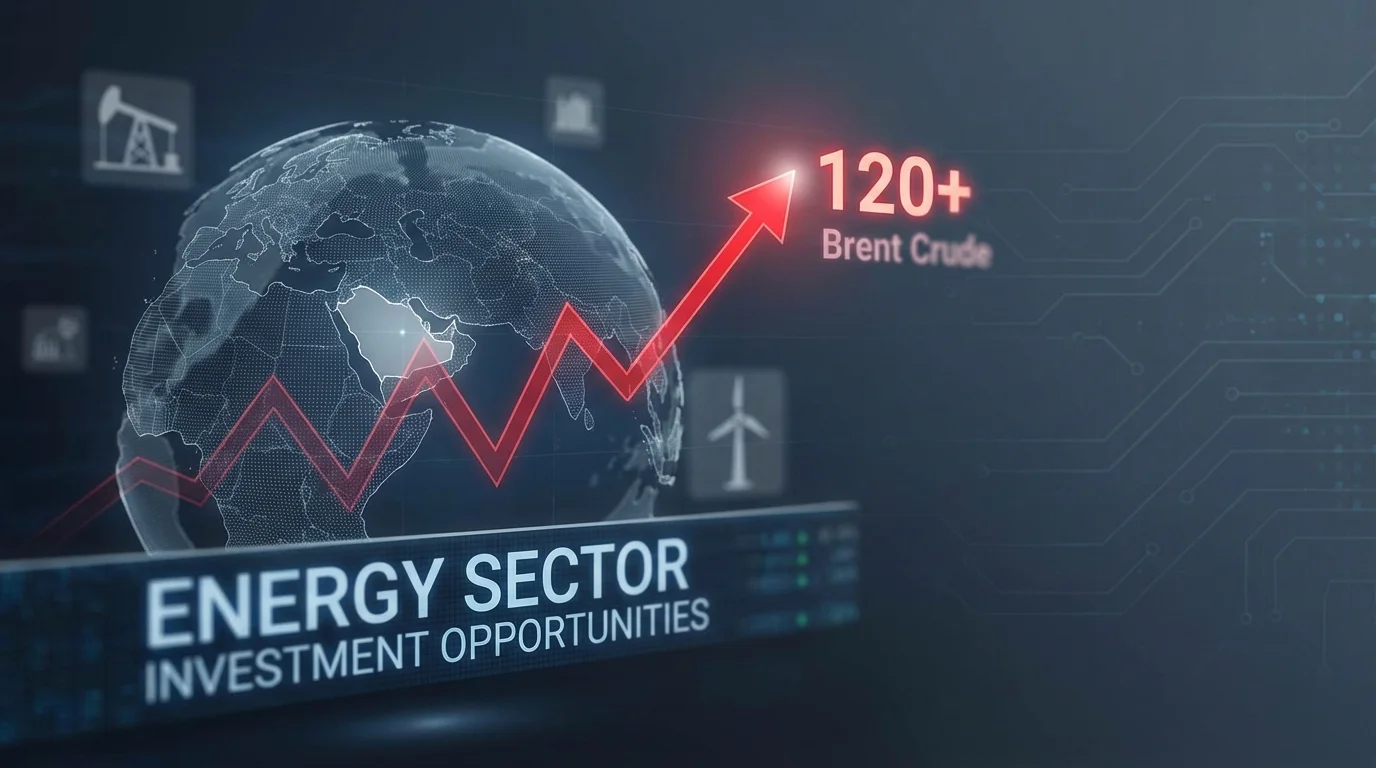
The 2026 US-Iran war has unleashed one of the most severe energy crises in modern history, with Iran's closure of the Strait of Hormuz disrupting approximately 20% of global oil supplies and sending Brent crude prices surging past $120 per barrel. This conflict, which began in early March 2026, has exposed critical vulnerabilities in global energy infrastructure and created unprecedented volatility across financial markets. Investors are now grappling with the dual challenge of navigating immediate price shocks while positioning portfolios for potentially prolonged disruptions that could see oil prices reach $150 to $200 per barrel according to analysts at Wood Mackenzie.
The economic implications extend far beyond energy markets. Barclays estimates that if oil prices average $100 in 2026, global growth would be 0.2 percentage points lower at 2.8%, while headline inflation would spike 0.7 percentage points higher to 3.8%. The five-year breakeven inflation rate has already risen 26 basis points since the conflict began, reaching its highest level since February 2025. For investors, this environment demands careful attention to energy sector opportunities while maintaining awareness of broader market risks tied to inflation and economic slowdown.
Want to stay ahead of market-moving events like the Iran crisis? Sign up for Intellectia.AI to get real-time alerts on energy stocks, oil price movements, and geopolitical risks that could impact your portfolio. Our AI-powered platform analyzes millions of data points to identify opportunities before the broader market catches on.

The Strait of Hormuz: The World's Most Dangerous Chokepoint
The Strait of Hormuz represents perhaps the single most critical geographic point for global energy security. This narrow waterway, just 35 miles wide at its narrowest point, handles approximately 25% of the world's seaborne oil and one-fifth of global liquefied natural gas (LNG) shipments. Before the 2026 conflict, roughly 21 million barrels of oil passed through the strait daily, making it the world's most important oil transit chokepoint.
When Iran closed the Strait of Hormuz on March 4, 2026, the immediate impact was catastrophic for energy markets. Major shipping firms including those from Qatar, Kuwait, Iraq, Saudi Arabia, and the United Arab Emirates suspended operations, effectively stranding millions of barrels of daily production. QatarEnergy was forced to declare force majeure on all exports, a move that reverberated through global LNG markets. The International Energy Agency, led by Fatih Birol, described the crisis as equivalent to the combined force of the twin oil shocks of the 1970s and the fallout from Russia's invasion of Ukraine.
The closure has revealed a fundamental vulnerability in global energy infrastructure that many analysts had warned about for years. Unlike other supply disruptions that can be partially offset through alternative routes or strategic reserves, the Strait of Hormuz represents a true bottleneck with no viable alternatives for the volumes involved. Pipeline capacity around the region is insufficient to handle more than a fraction of the displaced oil, and the cost of rerouting shipments around Africa adds both time and expense that markets simply cannot absorb without significant price adjustments.
Oil Price Surge: From $55 to $120 and Beyond
The trajectory of oil prices since the conflict began tells a dramatic story of market panic and shifting expectations. West Texas Intermediate (WTI) crude oil surged from $55.44 per barrel before the conflict to over $90 per barrel in late March, while Brent crude, the global benchmark, climbed nearly 1.8% to reach $101.70 per barrel. At the peak of tensions, Brent briefly exceeded $114 per barrel as markets priced in the possibility of direct attacks on Iranian energy infrastructure.
Goldman Sachs responded to the crisis by dramatically revising its 2026 Brent crude forecast upward from $77 to $85 per barrel, citing prolonged disruptions in Strait of Hormuz shipments and increased strategic stockpiling that are tightening global markets. However, even this revised forecast may prove conservative if the conflict continues. Wood Mackenzie analysts have warned that $200 per barrel oil is "not outside the realm of possibility" in 2026, a level that would surpass the all-time inflation-adjusted highs reached during the 2008 financial crisis.
The volatility has been extreme. On March 23, 2026, President Trump's announcement of "productive conversations" with Iran about ending the war triggered a sharp reversal, with oil prices tumbling and stock markets rallying. However, experts caution that the Iran war is too complex for simple "TACO trade" (Trump Always Chickens Out) dynamics to apply consistently. The fundamental supply disruption remains unresolved, and any breakdown in negotiations could send prices spiraling upward once again.
Global Economic Consequences: Inflation and Growth at Risk
The economic fallout from the Iran war extends far beyond energy markets, threatening to derail global growth while simultaneously reigniting inflationary pressures that central banks had been working to contain. The Barclays scenario analysis provides sobering numbers: sustained $100 oil would reduce global growth by 0.2 percentage points while boosting inflation by 0.7 percentage points. These effects compound existing economic headwinds and could force central banks to maintain higher interest rates for longer than markets currently anticipate.
The impact on consumer prices is already being felt. Fuel prices have spiked globally, creating what the International Road Transport Union describes as high and volatile conditions that are straining logistics networks and transportation costs. But the consequences run deeper than just gasoline prices. As Harvard economist James Stock noted, "Petroleum goes into everything," meaning the inflationary impact could cascade through plastics, fertilizers, chemicals, and countless manufactured goods. The Atlantic Council has warned that the strait's closure will tighten petrochemical and fertilizer markets with significant geopolitical and economic implications, potentially benefiting energy exporters like Russia while hurting American consumers.
The Federal Reserve finds itself in an increasingly difficult position. The futures market is now showing a 60% implied probability that the Fed will leave benchmark rates unchanged for the remainder of 2026, reflecting the challenge of addressing inflation without exacerbating growth slowdown. Joe Davis, global chief economist at Vanguard, noted that the Fed's decision to hold rates steady "is really emblematic of the tensions in the US economy and for the financial markets." This policy uncertainty adds another layer of risk for investors trying to navigate the current environment.
Energy Sector Investment Opportunities
Despite the broader market challenges, the Iran war has created significant opportunities in the energy sector for investors who can navigate the volatility. The Energy Select Sector SPDR ETF (XLE) has advanced approximately 34% over the past year, with particularly strong performance in March 2026 as oil prices surged. The VanEck Oil Services ETF (OIH) has gained an impressive 57%, reflecting the increased capital spending and drilling activity that higher prices typically stimulate.
Among individual stocks, the integrated oil majors offer defensive characteristics with upside exposure to rising prices. ExxonMobil (XOM) and Chevron (CVX) have both been highlighted by analysts as companies built to survive price volatility while continuing to reward shareholders with reliable dividends. These companies benefit from diversified operations spanning upstream production, refining, and marketing, which helps cushion the impact of price swings while capturing value across the entire energy value chain.
Refiners have also emerged as compelling opportunities in this environment. Goldman Sachs has turned bullish on the refining sector, naming Valero Energy (VLO), HF Sinclair (DINO), and Marathon Petroleum (MPC) as top picks. Higher oil prices, paradoxically, can benefit refiners by allowing them to widen margins as product prices adjust. Marathon Petroleum has been particularly aggressive with share buybacks while delivering strong performance, with the stock up 56% over the past year and nearly 500% since February 2020.
Strategic Considerations for Energy Investors
Investors looking to capitalize on the current energy environment should consider several strategic factors beyond simply picking individual stocks. The SPDR S&P Oil & Gas Exploration & Production Select Industry Index (XOP) offers exposure to upstream activities through an equal-weighted structure that provides greater exposure to mid- and small-cap companies compared to market-cap weighted alternatives like XLE. This can amplify gains in a rising price environment, though it also increases volatility.
The oil services segment, captured through OIH, represents a leveraged play on upstream capital spending. As producers increase drilling activity in response to higher prices, demand for drilling equipment, services, and technology increases disproportionately. This segment has already demonstrated this leverage with 57% gains, and continued high prices could drive further outperformance.
For investors seeking income alongside capital appreciation, midstream energy companies like Energy Transfer LP (ET) offer attractive dividend yields while providing exposure to the infrastructure that moves hydrocarbons from production fields to refineries and markets. These businesses typically operate on fee-based models that are less sensitive to commodity price fluctuations, providing more stable cash flows.
What Investors Should Watch Going Forward
The situation in the Middle East remains highly fluid, and investors should monitor several key developments that could significantly impact energy markets and broader portfolios. First and foremost, any news regarding negotiations between the US and Iran should be watched closely. President Trump's statements about "productive conversations" have already demonstrated the market's sensitivity to diplomatic developments, with oil prices swinging violently on headlines.
The status of the Strait of Hormuz remains the critical supply variable. Even partial reopening of the waterway could relieve significant price pressure, while continued closure or escalation to attacks on actual energy infrastructure could drive prices substantially higher. Barclays has raised its 2026 year-end S&P 500 target to 7,650 despite Middle East and inflation risks, suggesting that equity markets could weather the storm if the conflict resolves within a reasonable timeframe.
Central bank policy decisions, particularly from the Federal Reserve, will also be crucial. The combination of higher oil-driven inflation and slowing growth creates a stagflationary scenario that central banks have historically struggled to address. If the Fed is forced to maintain higher rates for longer, growth-oriented sectors could face headwinds even as energy companies benefit from elevated prices.
Conclusion
The 2026 Iran war and its associated oil price shock represent a defining moment for global energy markets and the broader economy. With the Strait of Hormuz closed and approximately 20% of global oil supplies disrupted, prices have surged to levels not seen in years, creating both risks and opportunities for investors. While the immediate human and geopolitical costs of the conflict are tragic, the economic implications demand careful attention from anyone with exposure to financial markets.
For investors, the current environment underscores the importance of energy sector diversification and the potential benefits of exposure to oil and gas producers, refiners, and services companies. The Energy Select Sector SPDR (XLE) and VanEck Oil Services ETF (OIH) have demonstrated that energy can provide both defensive characteristics and significant upside in commodity price rallies. Individual stocks like ExxonMobil, Chevron, and Marathon Petroleum offer various ways to capture this opportunity while managing risk.
However, the situation remains highly uncertain. Analyst forecasts for oil prices range from Goldman's $85 per barrel baseline to Wood Mackenzie's $200 per barrel stress scenario, reflecting the wide range of possible outcomes depending on how the conflict evolves. Investors should size positions appropriately for their risk tolerance and maintain flexibility to adjust as circumstances change.
Ready to identify the best energy stocks and time your entries and exits with precision? Try Intellectia.AI's AI Stock Picker to discover which oil and gas companies are positioned to benefit most from current market conditions. Our AI-powered stock screener can help you filter through thousands of energy sector opportunities to find the best matches for your investment criteria. Don't let market volatility catch you off guard—get the AI-driven insights you need to invest with confidence.