
Key Takeaway
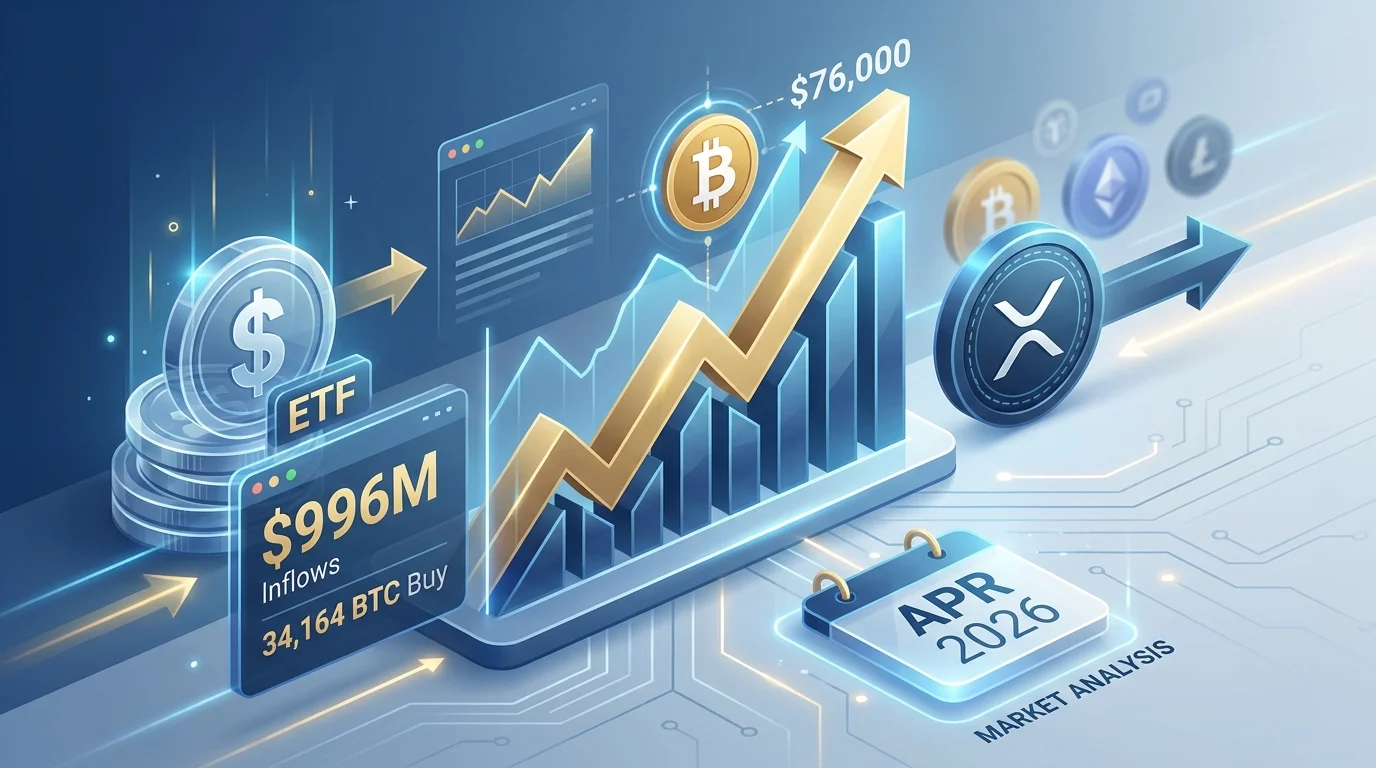
Bitcoin has staged a remarkable recovery in April 2026, climbing from the $74,000 level to break above $76,000 as institutional capital floods back into the cryptocurrency through spot ETF vehicles. The world's largest cryptocurrency has gained approximately 23% from its February cycle low of around $60,000, signaling renewed confidence among institutional investors despite ongoing macroeconomic uncertainties. This resurgence is being driven by a perfect storm of factors: BlackRock's iShares Bitcoin Trust (IBIT) attracting massive inflows, Strategy (formerly MicroStrategy) making its third-largest Bitcoin purchase on record, and a broader rotation of capital back into digital assets as traditional markets grapple with geopolitical tensions.
The significance of this Bitcoin ETF recovery extends beyond price action. For the first time since early 2026, Bitcoin spot ETFs have recorded their first monthly gain, ending a four-month streak of outflows and selling pressure. BlackRock's IBIT alone has seen over $900 million in inflows recently, with the firm's total Bitcoin ETF holdings now exceeding $61 billion. Meanwhile, Strategy has purchased 34,164 Bitcoin for approximately $2.54 billion at an average price of $74,395 per coin, bringing the company's total holdings to 815,061 BTC. This level of institutional accumulation suggests that smart money is positioning for a potential breakout beyond the $80,000 level, with prediction markets currently pricing a 42.5% probability of Bitcoin reaching that milestone before month-end.
However, the market dynamics reveal a nuanced picture. While Bitcoin is attracting significant institutional attention, Ethereum ETFs continue to face persistent outflows, and the broader altcoin market remains fragmented. XRP has emerged as the standout performer among major altcoins, delivering over 10% gains in April and outpacing BTC, ETH, and SOL. This divergence suggests that institutional demand is being selective rather than broad-based, with Bitcoin maintaining its status as the preferred crypto exposure vehicle for traditional finance players.

The Bitcoin ETF Recovery Story: From Outflows to $996 Million Weekly Inflows
The transformation of Bitcoin ETF flows from persistent outflows to nearly $1 billion in weekly inflows represents one of the most significant shifts in institutional sentiment this year. According to SoSoValue data, spot Bitcoin ETFs recorded approximately $996.4 million in net inflows last week alone, marking the largest weekly net inflow since mid-January 2026. This surge has successfully pushed total year-to-date flows into positive territory, reaching approximately $245 million and effectively reversing the previous four months of capital flight.
The mechanics of this recovery are particularly noteworthy. BlackRock's IBIT has been the primary beneficiary, attracting $214 million in a single day and extending its impressive inflow streak to five consecutive trading sessions. This dominance reflects both BlackRock's unparalleled distribution network and growing institutional comfort with regulated Bitcoin exposure vehicles. The firm's recent $284 million daily inflow demonstrates that institutional appetite extends beyond retail-driven speculation, with pension funds, endowments, and corporate treasuries increasingly viewing Bitcoin as a legitimate portfolio allocation.
What's driving this renewed institutional interest? Several factors appear to be converging. First, the resolution of various regulatory uncertainties surrounding cryptocurrency custody and accounting has removed significant friction for institutional adoption. Second, Bitcoin's correlation with traditional risk assets has decreased, making it an increasingly attractive diversification tool for portfolio managers seeking uncorrelated returns. Third, the supply dynamics created by ETF accumulation are creating a structural bid in the market, with institutional buying effectively removing Bitcoin from circulating supply and creating upward price pressure.
The technical implications of these inflows are equally significant. Bitcoin's price recovery has been accompanied by improving on-chain metrics, with the number of addresses holding over 1,000 BTC increasing by 3.2% month-over-month. This whale accumulation, combined with ETF inflows, suggests that the current rally has more substance than previous speculative episodes. The $70,000-$76,000 range has established itself as a critical support zone, with multiple tests confirming institutional buying interest at these levels.
Strategy's Record Bitcoin Purchase: What 34,164 BTC Signals About Corporate Adoption
Strategy's announcement on April 20, 2026, that it had acquired 34,164 Bitcoin for approximately $2.54 billion sent shockwaves through the cryptocurrency market. This purchase, completed at an average price of $74,395 per Bitcoin, represents the company's third-largest acquisition on record and brings its total holdings to an astounding 815,061 BTC. To put this in perspective, Strategy now holds more Bitcoin than many sovereign nations and has effectively surpassed BlackRock's IBIT as the largest corporate Bitcoin holder in the world.
Michael Saylor's conviction in Bitcoin as a treasury reserve asset has been unwavering since the company first began accumulating in 2020. What makes this latest purchase particularly significant is the timing and scale. Rather than scaling back during market uncertainty, Strategy has accelerated its accumulation, using a combination of equity offerings and debt financing to fund the acquisition. The $2.54 billion purchase demonstrates that corporate treasuries are not only maintaining their Bitcoin positions but actively increasing them, viewing the recent price weakness as a buying opportunity rather than a cause for concern.
The financial engineering behind Strategy's Bitcoin accumulation strategy deserves attention. The company has effectively transformed itself into a leveraged Bitcoin vehicle, with the stock price exhibiting amplified moves relative to the underlying cryptocurrency. This has created a unique arbitrage opportunity for investors seeking Bitcoin exposure through traditional brokerage accounts, with MSTR shares trading at a premium that reflects both the Bitcoin holdings and the company's enterprise software business. The recent $3.6 billion gain on Strategy's Bitcoin holdings in April alone validates this strategy and provides a template for other corporations considering Bitcoin adoption.
However, this aggressive accumulation strategy is not without risks. Strategy carries significant debt obligations, and the company's ability to service this debt depends in part on Bitcoin's price performance. Yet Michael Saylor's continued conviction suggests that he views these risks as manageable relative to the potential upside. The company's latest purchase at $74,395 per Bitcoin implies a belief that current prices represent a long-term value entry point, a sentiment that appears to be shared by other institutional participants.
The broader implications for corporate Bitcoin adoption are profound. Strategy's success in using Bitcoin as a treasury reserve asset has attracted attention from other public companies, with several firms announcing similar strategies in recent months. As more corporations follow Strategy's lead, the institutional demand for Bitcoin could accelerate significantly, creating a virtuous cycle of adoption and price appreciation. The fact that Strategy has now accumulated over 815,000 BTC demonstrates that institutional-grade Bitcoin accumulation is not only possible but increasingly common.
XRP Leads Altcoin Rally as Market Divergence Deepens
While Bitcoin has captured headlines with its institutional inflows, XRP has quietly emerged as the standout performer among major altcoins in April 2026. With over 10% gains recorded in the past week alone, XRP has outperformed Bitcoin, Ethereum, and Solana, establishing itself as the leader of the altcoin recovery. This performance is particularly notable given XRP's prolonged consolidation phase following the SEC litigation resolution, suggesting that the cryptocurrency may be entering a new phase of institutional acceptance.
The technical setup for XRP has improved considerably, with the price stabilizing near the $1.20-$1.30 demand zone after months of corrective price action. Analyst price targets for 2026 range from $2.71 on the conservative side to $5.00 or higher in bullish scenarios, reflecting the potential for significant upside if the current momentum continues. The 23% surge in XRP's price following recent regulatory clarity demonstrates the substantial pent-up demand that existed during the litigation period, with institutional investors now able to allocate to the asset without legal overhang concerns.
What's driving XRP's outperformance? Several factors appear to be contributing. First, Ripple's ongoing partnerships with financial institutions continue to expand, with the company announcing several new cross-border payment corridors in recent months. These real-world use cases differentiate XRP from many other cryptocurrencies that lack practical applications. Second, the resolution of regulatory uncertainty has removed a significant barrier to institutional adoption, with several asset managers now considering XRP for their crypto allocation strategies. Third, the broader altcoin market has been starved of positive catalysts, making XRP's relative strength particularly noticeable.
However, the broader altcoin market tells a more complex story. While XRP has surged, Ethereum continues to face challenges, with spot Ethereum ETFs recording persistent outflows and the network grappling with competition from layer-2 solutions and alternative layer-1 blockchains. The divergence between Bitcoin and Ethereum performance reflects a flight to quality within the cryptocurrency ecosystem, with institutional investors prioritizing Bitcoin's established store-of-value narrative over Ethereum's more complex smart contract platform thesis.
This market divergence has significant implications for portfolio construction. The traditional crypto portfolio approach of holding a basket of large-cap cryptocurrencies is being challenged by the increasingly divergent performance trajectories. Investors may need to become more selective in their altcoin allocations, focusing on assets with genuine utility and institutional backing rather than broad market exposure. XRP's recent performance suggests that regulatory clarity and real-world use cases are becoming increasingly important differentiators in a maturing market.
Ethereum ETF Outflows: Why Institutional Demand Remains Elusive
While Bitcoin ETFs have experienced a remarkable recovery, Ethereum spot ETFs continue to face persistent outflows, posting $46 million in net outflows for a fifth consecutive month. This divergence between the two major cryptocurrencies raises important questions about institutional preferences and the relative value propositions of Bitcoin versus Ethereum. Understanding why institutional capital is flowing into Bitcoin while fleeing Ethereum is crucial for predicting the next phase of the crypto market cycle.
The fundamental difference in institutional adoption patterns stems from the distinct narratives surrounding each asset. Bitcoin has successfully positioned itself as digital gold—a scarce, decentralized store of value that offers portfolio diversification benefits. This simple narrative resonates with traditional finance professionals who can easily conceptualize Bitcoin within existing asset allocation frameworks. Ethereum, by contrast, represents a more complex value proposition as a programmable blockchain platform, requiring investors to understand smart contracts, decentralized applications, and the broader Web3 ecosystem.
Recent data suggests that Ethereum's challenges extend beyond narrative difficulties. The network has faced increasing competition from layer-2 solutions like Arbitrum and Optimism, which offer lower transaction costs while inheriting Ethereum's security guarantees. This fragmentation of the Ethereum ecosystem has created uncertainty about value accrual to the ETH token, with transaction fees increasingly flowing to layer-2 tokens rather than Ethereum validators. Institutional investors may be waiting for greater clarity on Ethereum's monetization strategy before committing significant capital.
The technical price action also reflects this institutional hesitancy. Ethereum has struggled to establish clear bullish momentum, with the price action remaining range-bound despite Bitcoin's breakout. The persistent ETF outflows suggest that institutional investors who allocated to Ethereum in 2024 are now reallocating to Bitcoin, viewing the risk-reward profile as more favorable in the current environment. Until Ethereum can demonstrate clear catalysts for value appreciation, this trend of relative underperformance may continue.
However, it's worth noting that Ethereum's fundamentals remain strong despite the price weakness. The network continues to process billions of dollars in daily transaction volume, and the upcoming protocol upgrades could improve the tokenomics by introducing deflationary pressure through fee burning. Patient investors may view the current underperformance as a buying opportunity, particularly if Ethereum can successfully navigate the competitive landscape and reestablish its dominance in the smart contract platform space.

Macro Environment: Geopolitical Tensions and Crypto's Safe Haven Narrative
The broader macroeconomic environment has played a significant role in shaping the recent crypto market dynamics. Escalating tensions in the Middle East, ongoing trade negotiations, and uncertainty surrounding central bank policy have created a risk-off environment that has traditionally been challenging for cryptocurrency prices. However, Bitcoin's resilience in the face of these headwinds suggests that the asset may be evolving beyond its correlation with traditional risk assets.
Traders appear increasingly focused on prospects for a peaceful resolution to ongoing conflicts, with Bitcoin and Ethereum both moving higher on signals of de-escalation. This sensitivity to geopolitical developments reflects the maturation of the cryptocurrency market, with institutional participation creating more sophisticated price discovery mechanisms. The fact that Bitcoin has maintained its $76,000 level despite ongoing macro uncertainty demonstrates the strength of institutional support at current prices.
The relationship between Bitcoin and traditional safe-haven assets like gold has also evolved. While gold has traditionally been the preferred hedge against geopolitical risk, Bitcoin's portability and ease of transfer make it an attractive alternative for certain investors. The recent inflows into Bitcoin ETFs during periods of heightened geopolitical tension suggest that some institutional investors are beginning to view Bitcoin as a complementary safe-haven asset rather than a purely speculative investment.
Central bank policy remains a critical variable for crypto markets. The path of interest rates will determine the relative attractiveness of yield-bearing assets versus Bitcoin, which offers no yield but potential capital appreciation. Recent commentary from Federal Reserve officials has suggested a more hawkish stance than previously anticipated, creating headwinds for risk assets. However, Bitcoin's continued strength despite these concerns suggests that the asset is increasingly being viewed as a long-term store of value rather than a short-term speculative trade.
Technical Analysis: Key Levels and Price Targets for Bitcoin
From a technical perspective, Bitcoin's breakout above $76,000 has established a bullish structure that could support further upside. The recovery from the February low of approximately $60,000 represents a 23% gain, with the price action forming a clear higher-low pattern that suggests the correction phase has concluded. Traders are now watching the $80,000 level as the next significant resistance, with prediction markets pricing a 42.5% probability of Bitcoin reaching this milestone before month-end.
The $70,000-$76,000 range has emerged as a critical support zone, with multiple tests confirming strong institutional buying interest at these levels. This range aligns with the 100-day moving average, which has historically provided support during bull market corrections. The fact that Bitcoin has reclaimed both the 100-day average and the downtrend line from the January highs suggests that momentum has shifted in favor of the bulls, though sustained follow-through will be necessary to confirm the trend reversal.
Volume analysis supports the bullish thesis, with on-chain data showing increased activity among large holders. The number of addresses holding over 1,000 BTC has increased by 3.2% month-over-month, indicating accumulation by wealthy investors. This whale activity, combined with ETF inflows, creates a supportive supply-demand dynamic that could sustain the current rally even in the face of broader market volatility.
Looking ahead, the path to $80,000 and beyond will likely depend on continued institutional inflows and favorable macro developments. A break above $80,000 would open the door to retest the all-time highs above $87,000, while a failure to hold the $74,000 support level could signal a return to the previous trading range. Traders should monitor ETF flow data closely, as institutional sentiment appears to be the primary driver of price action in the current environment.
What This Recovery Means for Crypto Investors
The Bitcoin ETF recovery represents a significant inflection point for the cryptocurrency market, signaling a potential shift from the bearish sentiment that dominated the first quarter of 2026. For investors, this recovery offers both opportunities and challenges that require careful navigation of the evolving market landscape.
The most significant takeaway is the validation of Bitcoin's institutional adoption thesis. The nearly $1 billion in weekly ETF inflows demonstrates that institutional capital is not only returning to the crypto market but doing so through regulated vehicles that offer traditional finance-friendly exposure. This institutionalization of Bitcoin investing reduces volatility over time and creates more stable demand dynamics, benefiting long-term holders.
However, the divergent performance between Bitcoin and altcoins like Ethereum suggests that investors need to become more selective in their allocations. The "rising tide lifts all boats" era of crypto investing may be giving way to a more discriminating environment where fundamental factors like regulatory clarity, institutional adoption, and real-world utility drive performance. XRP's outperformance relative to Ethereum illustrates the importance of these fundamental factors in the current market environment.
Risk management remains crucial despite the improving technical picture. The geopolitical and macroeconomic environment remains uncertain, and Bitcoin's correlation with traditional risk assets, while decreasing, has not been eliminated entirely. Investors should maintain appropriate position sizing and diversification strategies, treating crypto as one component of a broader portfolio rather than an all-in bet.
For those considering entering the market, the current environment offers a compelling risk-reward setup. Bitcoin has established clear support levels, institutional demand is accelerating, and the technical structure suggests further upside potential. However, investors should be prepared for volatility and maintain a long-term perspective, recognizing that crypto markets can experience sharp drawdowns even during bull market phases.
Conclusion: The Path Forward for Bitcoin and Crypto Markets
Bitcoin's recovery above $76,000 marks a pivotal moment in the cryptocurrency market's evolution from a speculative asset class to an institutional-grade investment vehicle. The convergence of ETF inflows, corporate treasury adoption, and improving technical structures suggests that the current rally has substance beyond short-term speculation. With BlackRock's IBIT attracting nearly $1 billion in weekly inflows and Strategy accumulating over 815,000 BTC, institutional conviction in Bitcoin's long-term value proposition has never been stronger.
However, the market's maturation is also creating a more complex landscape for investors. The divergence between Bitcoin's institutional-driven recovery and Ethereum's continued struggles reflects the increasing importance of fundamental factors in crypto investing. As the market evolves, investors will need to become more sophisticated in their analysis, focusing on regulatory clarity, institutional adoption metrics, and real-world utility rather than relying on broad market exposure.
Looking ahead, the key catalysts for continued Bitcoin appreciation include sustained ETF inflows, potential corporate treasury adoption following Strategy's example, and favorable macroeconomic developments. The $80,000 level represents the next significant psychological barrier, with a break above this level potentially triggering a new wave of FOMO buying from retail investors who have been waiting on the sidelines.
For investors seeking exposure to this emerging asset class, the current environment offers compelling opportunities but also requires careful risk management. The increasing institutionalization of Bitcoin reduces some of the volatility risks that have historically characterized crypto markets, but the asset remains significantly more volatile than traditional investments. A measured approach that treats crypto as a portfolio allocation rather than a speculative bet is likely to yield the best long-term results.
Ready to take advantage of the Bitcoin ETF recovery? Sign up for Intellectia.ai today to access AI-powered crypto analysis, real-time market signals, and institutional-grade research tools. Our platform provides the insights you need to navigate the evolving cryptocurrency landscape and identify the best opportunities in both Bitcoin and altcoin markets. Explore our AI Screener to discover crypto assets with strong institutional backing and learn about our AI Stock Picker for comprehensive market analysis that gives you an edge in today's fast-moving markets.