Understanding Netstreit: Key Takeaways from 7 Analyst Evaluations
Analyst Sentiment: Seven analysts have provided varied opinions on Netstreit, with recent ratings showing a mix of bullish and somewhat bullish sentiments, and an average 12-month price target of $20.00, reflecting a 10.25% increase from the previous target.
Financial Performance: Netstreit has demonstrated strong revenue growth of 22.76% over the last three months, although its net margin, return on equity, and return on assets are below industry standards, indicating challenges in profitability and asset utilization.
Trade with 70% Backtested Accuracy
Analyst Views on NTST

About NTST
About the author


NETSTREIT Corp. Receives BBB- Rating from Fitch, Reflecting Strong Operational Performance

- Rating Upgrade: Fitch has assigned NETSTREIT a BBB- issuer rating, reflecting the company's strong operational performance with over 99% occupancy during the pandemic, which enhances investor confidence and validates its solid property portfolio.
- Financial Flexibility: This rating allows NETSTREIT to achieve substantial interest expense savings across its revolving credit and term loan facilities, not only improving the company's financial flexibility but also providing a more efficient pathway for accessing capital markets in the future.
- Management Team Strength: Led by seasoned commercial real estate executives, NETSTREIT's strategy focuses on acquiring single-tenant net lease retail properties, ensuring competitiveness in high-quality asset portfolios and generating consistent cash flows and dividends for investors.
- Long-term Growth Potential: The attainment of an investment-grade rating underscores the company's commitment to conservatively managing its balance sheet and maintaining a low leverage profile, which is expected to attract more institutional investors and further drive long-term growth potential.

NTST Surpasses 5% Yield Threshold
Dividend Predictability: Dividend amounts are generally unpredictable and fluctuate based on a company's profitability.
NetSTREIT Corp Analysis: Analyzing the historical dividend chart for NetSTREIT Corp (NTST) can provide insights into the likelihood of maintaining a 5% annual yield.
Investment Opportunities: There is a mention of other dividend stocks that have recently become available for purchase.
Author's Perspective: The opinions expressed in the article are those of the author and do not necessarily represent Nasdaq, Inc.

Upcoming Ex-Dividend Dates for NBT Bancorp, NetSTREIT, and Virtu Financial

Upcoming Ex-Dividend Dates: NBT Bancorp. Inc., NetSTREIT Corp, and Virtu Financial Inc Class A will trade ex-dividend on 12/1/25, with respective dividends of $0.37, $0.215, and $0.24 payable on 12/15/25.
Expected Price Adjustments: Following the ex-dividend date, shares of NBT Bancorp. Inc. are expected to drop by 0.88%, NetSTREIT Corp by 1.18%, and Virtu Financial Inc Class A by 0.68%, based on their recent stock prices.
Dividend Yield Estimates: The estimated annualized yields for the companies are 3.51% for NBT Bancorp. Inc., 4.71% for NetSTREIT Corp, and 2.72% for Virtu Financial Inc Class A, indicating potential stability in their dividend payments.
Market Performance: As of the latest trading day, NBT Bancorp. Inc. shares are down 0.5%, while NetSTREIT Corp and Virtu Financial Inc Class A shares have increased by 0.4% and 1.8%, respectively.

Analysts Predict 12% Growth for RWR in the Future


ETF Analysis: The SPDR Dow Jones REIT ETF (RWR) has an implied analyst target price of $110.97, indicating a potential upside of 12.11% from its current trading price of $98.99.
Notable Holdings: Key underlying holdings with significant upside potential include Federal Realty Investment Trust (FRT), NNN REIT Inc (NNN), and NetSTREIT Corp (NTST), with expected price increases of 13.05%, 13.02%, and 12.51% respectively.
Market Sentiment: The analysis raises questions about whether analysts' target prices are justified or overly optimistic, suggesting the need for further investor research into recent company and industry developments.
Cautionary Note: A high target price relative to a stock's current price may indicate optimism but could also lead to potential downgrades if the targets are based on outdated information.

Analysts Raise Netstreit Forecasts After Q3 Results
Quarterly Performance: NetSTREIT Corp reported a third-quarter FFO of 33 cents per share, surpassing the analyst estimate of 32 cents, and sales of $48.308 million, exceeding the expected $46.223 million.
Future Guidance: The company affirmed its FY2025 FFO guidance of $1.29-$1.31, highlighting strong execution and a well-positioned portfolio for future growth.
Market Reaction: Despite the positive earnings report, NetSTREIT shares fell 3.4% to $18.88 on Tuesday.
Analyst Ratings: Analysts from Baird and Stifel maintained their ratings on NetSTREIT, both raising the price target from $20 to $21 following the earnings announcement.
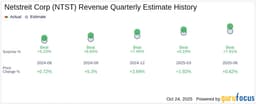
Upcoming Earnings: Netstreit Corp (NTST) Announces Q3 2025 Results
Earnings Release and Estimates: Netstreit Corp (NYSE:NTST) is set to release its Q3 2025 earnings on October 27, with revenue expected at $46.22 million and earnings at $0.06 per share. Full year 2025 revenue is projected to be $186.14 million, with earnings of $0.20 per share.
Revenue and Earnings Adjustments: Over the past 90 days, revenue estimates for 2025 have increased, while earnings estimates have declined, indicating a mixed outlook for the company.
Recent Performance: In Q2 2025, Netstreit reported revenue of $48.29 million, exceeding expectations, but earnings of $0.04 per share fell short of analyst predictions, leading to a slight stock increase of 0.62%.
Analyst Recommendations and Price Targets: The average target price for NTST is $20.14, suggesting a potential upside of 4.40%, with a consensus recommendation of "Outperform" from brokerage firms.
NETSTREIT Corp. Receives BBB- Rating from Fitch, Reflecting Strong Operational Performance
- Rating Upgrade: Fitch has assigned NETSTREIT a BBB- issuer rating, reflecting the company's strong operational performance with over 99% occupancy during the pandemic, which enhances investor confidence and validates its solid property portfolio.
- Financial Flexibility: This rating allows NETSTREIT to achieve substantial interest expense savings across its revolving credit and term loan facilities, not only improving the company's financial flexibility but also providing a more efficient pathway for accessing capital markets in the future.
- Management Team Strength: Led by seasoned commercial real estate executives, NETSTREIT's strategy focuses on acquiring single-tenant net lease retail properties, ensuring competitiveness in high-quality asset portfolios and generating consistent cash flows and dividends for investors.
- Long-term Growth Potential: The attainment of an investment-grade rating underscores the company's commitment to conservatively managing its balance sheet and maintaining a low leverage profile, which is expected to attract more institutional investors and further drive long-term growth potential.
NTST Surpasses 5% Yield Threshold
Dividend Predictability: Dividend amounts are generally unpredictable and fluctuate based on a company's profitability.
NetSTREIT Corp Analysis: Analyzing the historical dividend chart for NetSTREIT Corp (NTST) can provide insights into the likelihood of maintaining a 5% annual yield.
Investment Opportunities: There is a mention of other dividend stocks that have recently become available for purchase.
Author's Perspective: The opinions expressed in the article are those of the author and do not necessarily represent Nasdaq, Inc.
Upcoming Ex-Dividend Dates for NBT Bancorp, NetSTREIT, and Virtu Financial
Upcoming Ex-Dividend Dates: NBT Bancorp. Inc., NetSTREIT Corp, and Virtu Financial Inc Class A will trade ex-dividend on 12/1/25, with respective dividends of $0.37, $0.215, and $0.24 payable on 12/15/25.
Expected Price Adjustments: Following the ex-dividend date, shares of NBT Bancorp. Inc. are expected to drop by 0.88%, NetSTREIT Corp by 1.18%, and Virtu Financial Inc Class A by 0.68%, based on their recent stock prices.
Dividend Yield Estimates: The estimated annualized yields for the companies are 3.51% for NBT Bancorp. Inc., 4.71% for NetSTREIT Corp, and 2.72% for Virtu Financial Inc Class A, indicating potential stability in their dividend payments.
Market Performance: As of the latest trading day, NBT Bancorp. Inc. shares are down 0.5%, while NetSTREIT Corp and Virtu Financial Inc Class A shares have increased by 0.4% and 1.8%, respectively.
Analysts Predict 12% Growth for RWR in the Future
ETF Analysis: The SPDR Dow Jones REIT ETF (RWR) has an implied analyst target price of $110.97, indicating a potential upside of 12.11% from its current trading price of $98.99.
Notable Holdings: Key underlying holdings with significant upside potential include Federal Realty Investment Trust (FRT), NNN REIT Inc (NNN), and NetSTREIT Corp (NTST), with expected price increases of 13.05%, 13.02%, and 12.51% respectively.
Market Sentiment: The analysis raises questions about whether analysts' target prices are justified or overly optimistic, suggesting the need for further investor research into recent company and industry developments.
Cautionary Note: A high target price relative to a stock's current price may indicate optimism but could also lead to potential downgrades if the targets are based on outdated information.
Analysts Raise Netstreit Forecasts After Q3 Results
Quarterly Performance: NetSTREIT Corp reported a third-quarter FFO of 33 cents per share, surpassing the analyst estimate of 32 cents, and sales of $48.308 million, exceeding the expected $46.223 million.
Future Guidance: The company affirmed its FY2025 FFO guidance of $1.29-$1.31, highlighting strong execution and a well-positioned portfolio for future growth.
Market Reaction: Despite the positive earnings report, NetSTREIT shares fell 3.4% to $18.88 on Tuesday.
Analyst Ratings: Analysts from Baird and Stifel maintained their ratings on NetSTREIT, both raising the price target from $20 to $21 following the earnings announcement.
Upcoming Earnings: Netstreit Corp (NTST) Announces Q3 2025 Results
Earnings Release and Estimates: Netstreit Corp (NYSE:NTST) is set to release its Q3 2025 earnings on October 27, with revenue expected at $46.22 million and earnings at $0.06 per share. Full year 2025 revenue is projected to be $186.14 million, with earnings of $0.20 per share.
Revenue and Earnings Adjustments: Over the past 90 days, revenue estimates for 2025 have increased, while earnings estimates have declined, indicating a mixed outlook for the company.
Recent Performance: In Q2 2025, Netstreit reported revenue of $48.29 million, exceeding expectations, but earnings of $0.04 per share fell short of analyst predictions, leading to a slight stock increase of 0.62%.
Analyst Recommendations and Price Targets: The average target price for NTST is $20.14, suggesting a potential upside of 4.40%, with a consensus recommendation of "Outperform" from brokerage firms.