Financial Dynamics Analysis of Ford and Tesla
Written by Emily J. Thompson, Senior Investment Analyst
Updated: 55 minutes ago
0mins
Source: Fool
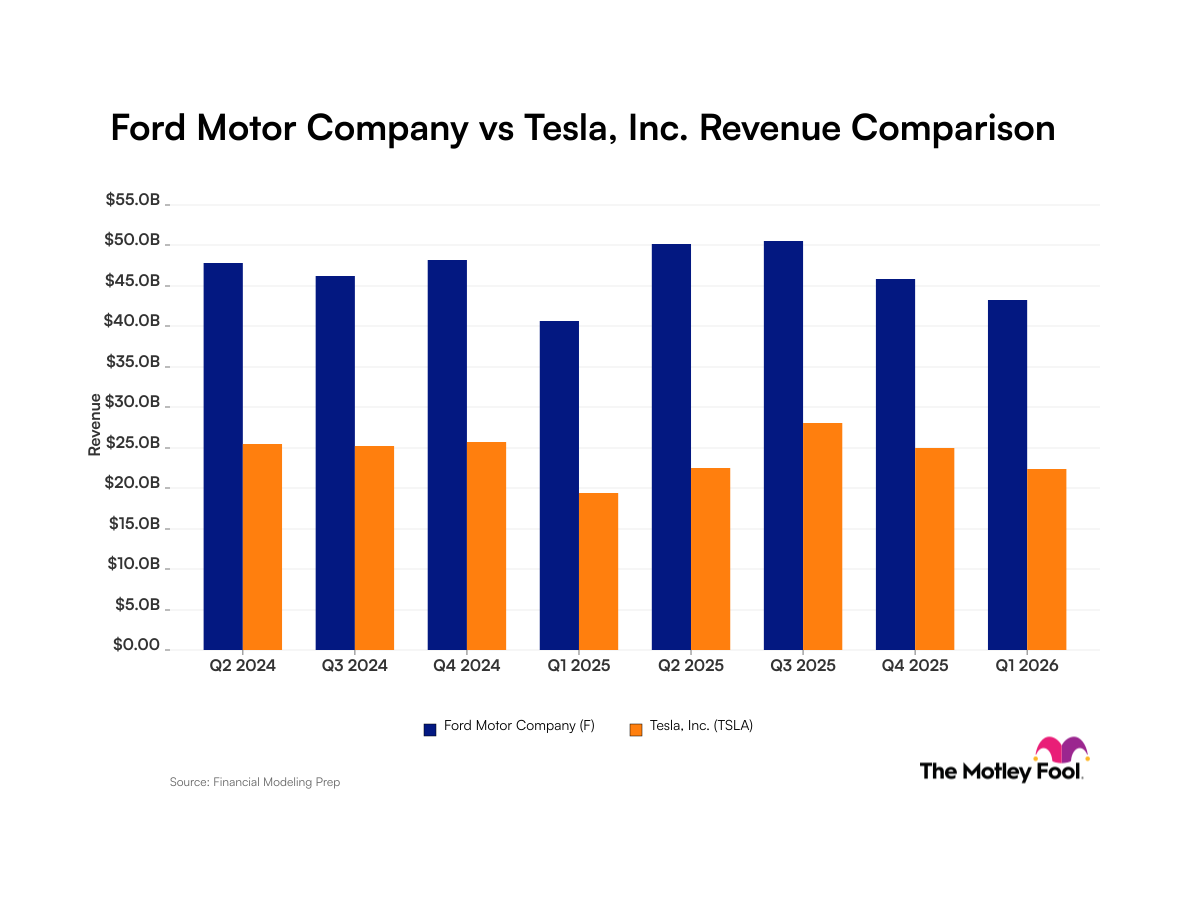
- Ford's Revenue Stability: Ford reported approximately $43.3 billion in revenue for Q1 2026, with a modest year-over-year growth of 6%, yet the establishment of a new product development organization is expected to enhance future innovation and market competitiveness.
- Tesla's Revenue Fluctuations: Tesla's revenue for Q1 2026 was $22.4 billion, reflecting a robust 16% year-over-year growth, despite challenges from workforce reductions and a transition to a subscription model for its Full Self-Driving software.
- Market Performance Comparison: While Ford's sales significantly exceed Tesla's, Ford's stock peaked at $14.95 over the past year, compared to Tesla's stock exceeding $400, indicating a market perception of Tesla's higher growth potential.
- Strategic Transformation Impact: Ford's newly established energy division aims to provide battery storage solutions, which may increase operational costs but also opens new revenue opportunities, while Tesla continues to enhance revenue through its autonomous ride-hailing service, maintaining its market leadership.
Trade with 70% Backtested Accuracy
Stop guessing "Should I Buy F?" and start using high-conviction signals backed by rigorous historical data.
Sign up today to access powerful investing tools and make smarter, data-driven decisions.
Analyst Views on F
Wall Street analysts forecast F stock price to fall
14 Analyst Rating
3 Buy
10 Hold
1 Sell
Hold
Current: 13.670

Low
11.00
Averages
13.65
High
16.00
Current: 13.670
Low
11.00
Averages
13.65
High
16.00
About F
Ford Motor Company develops and delivers Ford trucks, sport utility vehicles, commercial vans and cars, and Lincoln luxury vehicles, along with connected services, including BlueCruise (ADAS) and security. The Company's segments include Ford Blue, Ford Model e, Ford Pro, and Ford Credit. The Ford Blue segment primarily includes the sale of Ford and Lincoln internal combustion engine (ICE) and hybrid vehicles, service parts, accessories, and digital services for retail customers. The Ford Model e segment primarily includes the sale of its electric vehicles, service parts, accessories, and digital services for retail customers. The Ford Pro segment primarily includes the sale of Ford and Lincoln vehicles, service parts, accessories, and services for commercial, government, and rental customers. The Ford Credit segment consists of the Ford Credit business on a consolidated basis, which is primarily vehicle-related financing and leasing activities. Its vehicle brands are Ford and Lincoln.
About the author

Emily J. Thompson
Emily J. Thompson, a Chartered Financial Analyst (CFA) with 12 years in investment research, graduated with honors from the Wharton School. Specializing in industrial and technology stocks, she provides in-depth analysis for Intellectia’s earnings and market brief reports.

Ford Faces Challenges and Opportunities in European Market

- Market Share Decline: Ford continues to struggle with declining market share in Europe, where its commercial vehicle segment performs well, but the passenger vehicle division faces significant profitability challenges, potentially leading to a future where only the commercial business remains in operation within five to ten years.
- New Model Launch Plans: By the end of 2029, Ford plans to launch five all-new passenger vehicles, including a new multi-energy compact SUV to be produced at its Spain plant in 2028, aiming to attract consumers by combining off-road design with on-road performance.
- Increased Chinese Competition: Chinese automakers doubled their market share in Europe last year to 6%, posing a direct threat to Ford with their compelling low-cost offerings and advanced electric vehicle technology, particularly in a fiercely competitive pricing environment.
- EU Tariff Policies: Although the European Union has imposed a 35% tariff on Chinese-made electric vehicles, this does not include plug-in hybrids or combustion engine vehicles, allowing Chinese manufacturers to maintain strong sales momentum in Europe, thereby increasing competitive pressure on Ford.
See More
Financial Dynamics Analysis of Ford and Tesla

- Ford's Revenue Stability: Ford reported approximately $43.3 billion in revenue for Q1 2026, with a modest year-over-year growth of 6%, yet the establishment of a new product development organization is expected to enhance future innovation and market competitiveness.
- Tesla's Revenue Fluctuations: Tesla's revenue for Q1 2026 was $22.4 billion, reflecting a robust 16% year-over-year growth, despite challenges from workforce reductions and a transition to a subscription model for its Full Self-Driving software.
- Market Performance Comparison: While Ford's sales significantly exceed Tesla's, Ford's stock peaked at $14.95 over the past year, compared to Tesla's stock exceeding $400, indicating a market perception of Tesla's higher growth potential.
- Strategic Transformation Impact: Ford's newly established energy division aims to provide battery storage solutions, which may increase operational costs but also opens new revenue opportunities, while Tesla continues to enhance revenue through its autonomous ride-hailing service, maintaining its market leadership.
See More
Ford vs Tesla Revenue Comparison
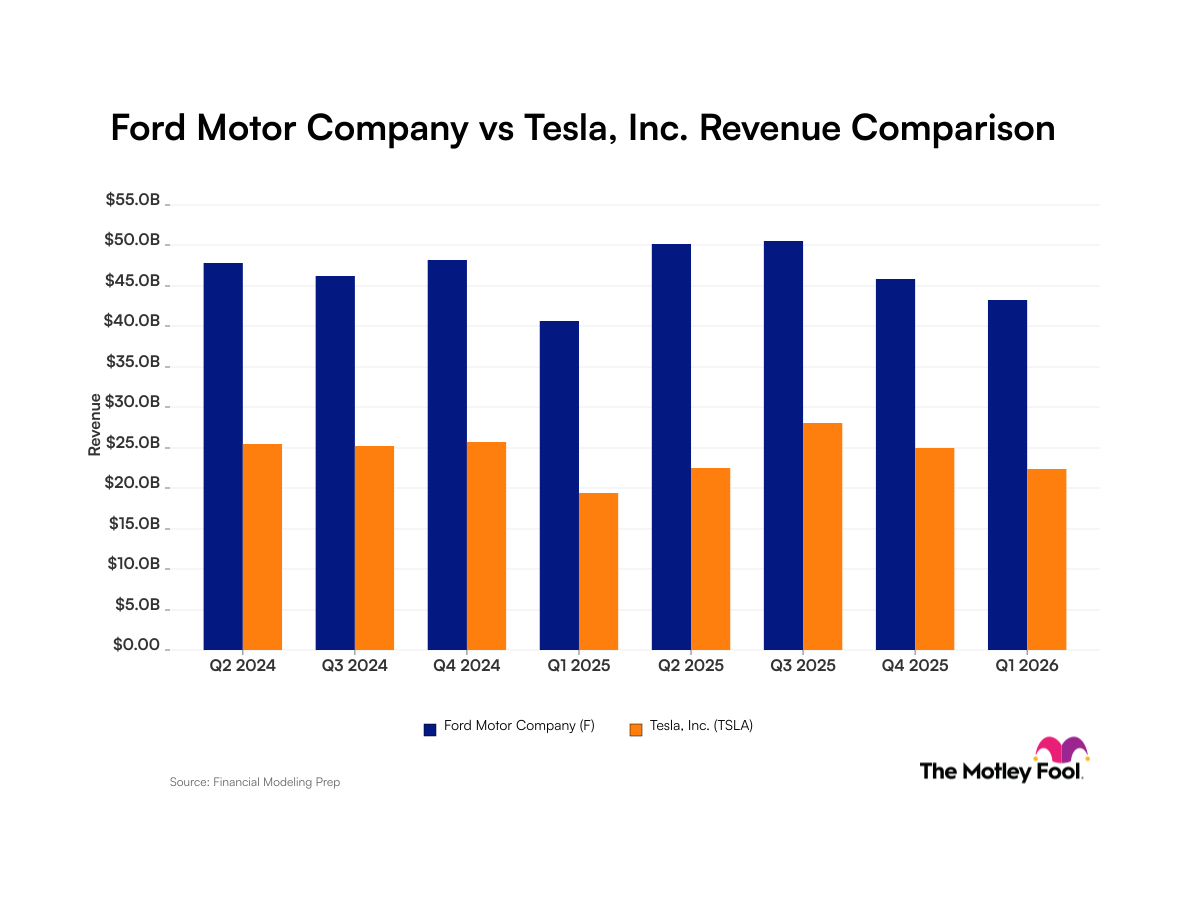
- Ford's Stable Revenue: Ford reported approximately $43.3 billion in revenue for Q1 2026, with a modest 6% year-over-year growth; however, the establishment of a new product development organization is expected to enhance future product innovation and market competitiveness.
- Tesla's Revenue Fluctuations: Tesla's revenue for Q1 2026 was $22.4 billion, reflecting a 16% year-over-year increase, and despite facing workforce reductions and transition challenges, the subscription model for its Full Self-Driving software may enhance long-term revenue stability.
- Market Performance Discrepancy: While Ford's revenue significantly exceeds Tesla's, Ford's stock reached a 52-week high of $14.95, compared to Tesla's stock exceeding $400, indicating a market expectation for Tesla's future growth potential that is higher than Ford's.
- Strategic Transformation Impact: Ford's newly established energy division will provide battery storage solutions, which may increase short-term costs, but in the long run, it is expected to bolster the company's competitiveness in the battery market, particularly against Tesla's already established presence.
See More

Ford's Challenges and Opportunities in the European Market
- New Model Launch Plan: Ford plans to introduce five all-new passenger vehicles by the end of 2029, including a new multi-energy rugged compact SUV from the global Bronco family to be produced at its Spain plant in 2028, aiming to enhance its competitiveness in the European market.
- Declining Market Share: Despite the launch of new models to tackle market challenges, Ford's market share in Europe has been declining for several years, particularly under the pressure of low-cost competition from Chinese automakers, which poses a significant threat to its passenger vehicle business.
- Chinese Competition Threat: Chinese automakers doubled their market share in Europe last year to 6%, driven by their compelling low-cost offerings and advanced electric vehicle technology, putting Ford at a disadvantage in price competition.
- Profitability Risks: Ford's passenger vehicle business in Europe continues to face losses, and if the new models fail to attract consumers effectively, it is conceivable that in the next five to ten years, Ford may only retain its high-margin commercial vehicle business, facing significant strategic transformation risks.
See More

Ford Signs Battery Storage Agreement with EDF
- Battery Storage Agreement: Ford Motor's large-scale battery storage framework agreement with EDF Power Solutions positions Ford Energy as a key supplier for grid-scale energy storage projects in the U.S., with deliveries expected to start in 2028, highlighting strong demand for domestically supplied utility-grade energy storage.
- Market Expectations Rise: Morgan Stanley analyst Andrew Percoco believes this agreement could be the first of several large customer announcements this year, estimating that Ford's energy business could generate approximately $0.10 of EPS once ramped to 20 GWh capacity, which could drive a higher valuation for the stock.
- Growing Energy Storage Demand: Ford's partnership with CATL reflects a broader shift in battery demand in the U.S., as the rapid growth of AI inference workloads is making power demand more volatile, indicating a structural shift towards stronger energy storage applications.
- Impact of Renewables: The increasing penetration of renewables necessitates energy storage as a practical solution to traditional power capacity constraints, and Ford's agreement not only strengthens its market position but also lays the groundwork for sustainable development in the future.
See More

Cadence Design Systems Sees Surge in Options Trading Volume


- Surge in Options Volume: Cadence Design Systems Inc experienced options trading volume of 15,350 contracts, equating to approximately 1.5 million shares, which represents about 63.4% of its average daily trading volume of 2.4 million shares over the past month, indicating strong market interest in the stock.
- High-Frequency Trading Insight: Notably, the $400 strike call option expiring on August 21, 2026, saw 5,026 contracts traded today, representing around 502,600 underlying shares, reflecting investor expectations for future price appreciation.
- Ford Options Activity: In parallel, Ford Motor Co's options trading volume reached 404,294 contracts, approximately 40.4 million shares, accounting for 60% of its average daily trading volume of 67.4 million shares over the past month, showcasing active trading in Ford's stock.
- High-Frequency Call Options: The $14 strike call option for Ford saw a trading volume of 32,882 contracts today, representing about 3.3 million shares, indicating optimistic sentiment among investors regarding the stock's future performance.
See More
Ford Faces Challenges and Opportunities in European Market
- Market Share Decline: Ford continues to struggle with declining market share in Europe, where its commercial vehicle segment performs well, but the passenger vehicle division faces significant profitability challenges, potentially leading to a future where only the commercial business remains in operation within five to ten years.
- New Model Launch Plans: By the end of 2029, Ford plans to launch five all-new passenger vehicles, including a new multi-energy compact SUV to be produced at its Spain plant in 2028, aiming to attract consumers by combining off-road design with on-road performance.
- Increased Chinese Competition: Chinese automakers doubled their market share in Europe last year to 6%, posing a direct threat to Ford with their compelling low-cost offerings and advanced electric vehicle technology, particularly in a fiercely competitive pricing environment.
- EU Tariff Policies: Although the European Union has imposed a 35% tariff on Chinese-made electric vehicles, this does not include plug-in hybrids or combustion engine vehicles, allowing Chinese manufacturers to maintain strong sales momentum in Europe, thereby increasing competitive pressure on Ford.
See More
Financial Dynamics Analysis of Ford and Tesla
- Ford's Revenue Stability: Ford reported approximately $43.3 billion in revenue for Q1 2026, with a modest year-over-year growth of 6%, yet the establishment of a new product development organization is expected to enhance future innovation and market competitiveness.
- Tesla's Revenue Fluctuations: Tesla's revenue for Q1 2026 was $22.4 billion, reflecting a robust 16% year-over-year growth, despite challenges from workforce reductions and a transition to a subscription model for its Full Self-Driving software.
- Market Performance Comparison: While Ford's sales significantly exceed Tesla's, Ford's stock peaked at $14.95 over the past year, compared to Tesla's stock exceeding $400, indicating a market perception of Tesla's higher growth potential.
- Strategic Transformation Impact: Ford's newly established energy division aims to provide battery storage solutions, which may increase operational costs but also opens new revenue opportunities, while Tesla continues to enhance revenue through its autonomous ride-hailing service, maintaining its market leadership.
See More
Ford vs Tesla Revenue Comparison
- Ford's Stable Revenue: Ford reported approximately $43.3 billion in revenue for Q1 2026, with a modest 6% year-over-year growth; however, the establishment of a new product development organization is expected to enhance future product innovation and market competitiveness.
- Tesla's Revenue Fluctuations: Tesla's revenue for Q1 2026 was $22.4 billion, reflecting a 16% year-over-year increase, and despite facing workforce reductions and transition challenges, the subscription model for its Full Self-Driving software may enhance long-term revenue stability.
- Market Performance Discrepancy: While Ford's revenue significantly exceeds Tesla's, Ford's stock reached a 52-week high of $14.95, compared to Tesla's stock exceeding $400, indicating a market expectation for Tesla's future growth potential that is higher than Ford's.
- Strategic Transformation Impact: Ford's newly established energy division will provide battery storage solutions, which may increase short-term costs, but in the long run, it is expected to bolster the company's competitiveness in the battery market, particularly against Tesla's already established presence.
See More
Ford's Challenges and Opportunities in the European Market
- New Model Launch Plan: Ford plans to introduce five all-new passenger vehicles by the end of 2029, including a new multi-energy rugged compact SUV from the global Bronco family to be produced at its Spain plant in 2028, aiming to enhance its competitiveness in the European market.
- Declining Market Share: Despite the launch of new models to tackle market challenges, Ford's market share in Europe has been declining for several years, particularly under the pressure of low-cost competition from Chinese automakers, which poses a significant threat to its passenger vehicle business.
- Chinese Competition Threat: Chinese automakers doubled their market share in Europe last year to 6%, driven by their compelling low-cost offerings and advanced electric vehicle technology, putting Ford at a disadvantage in price competition.
- Profitability Risks: Ford's passenger vehicle business in Europe continues to face losses, and if the new models fail to attract consumers effectively, it is conceivable that in the next five to ten years, Ford may only retain its high-margin commercial vehicle business, facing significant strategic transformation risks.
See More
Ford Signs Battery Storage Agreement with EDF
- Battery Storage Agreement: Ford Motor's large-scale battery storage framework agreement with EDF Power Solutions positions Ford Energy as a key supplier for grid-scale energy storage projects in the U.S., with deliveries expected to start in 2028, highlighting strong demand for domestically supplied utility-grade energy storage.
- Market Expectations Rise: Morgan Stanley analyst Andrew Percoco believes this agreement could be the first of several large customer announcements this year, estimating that Ford's energy business could generate approximately $0.10 of EPS once ramped to 20 GWh capacity, which could drive a higher valuation for the stock.
- Growing Energy Storage Demand: Ford's partnership with CATL reflects a broader shift in battery demand in the U.S., as the rapid growth of AI inference workloads is making power demand more volatile, indicating a structural shift towards stronger energy storage applications.
- Impact of Renewables: The increasing penetration of renewables necessitates energy storage as a practical solution to traditional power capacity constraints, and Ford's agreement not only strengthens its market position but also lays the groundwork for sustainable development in the future.
See More
Cadence Design Systems Sees Surge in Options Trading Volume
- Surge in Options Volume: Cadence Design Systems Inc experienced options trading volume of 15,350 contracts, equating to approximately 1.5 million shares, which represents about 63.4% of its average daily trading volume of 2.4 million shares over the past month, indicating strong market interest in the stock.
- High-Frequency Trading Insight: Notably, the $400 strike call option expiring on August 21, 2026, saw 5,026 contracts traded today, representing around 502,600 underlying shares, reflecting investor expectations for future price appreciation.
- Ford Options Activity: In parallel, Ford Motor Co's options trading volume reached 404,294 contracts, approximately 40.4 million shares, accounting for 60% of its average daily trading volume of 67.4 million shares over the past month, showcasing active trading in Ford's stock.
- High-Frequency Call Options: The $14 strike call option for Ford saw a trading volume of 32,882 contracts today, representing about 3.3 million shares, indicating optimistic sentiment among investors regarding the stock's future performance.
See More